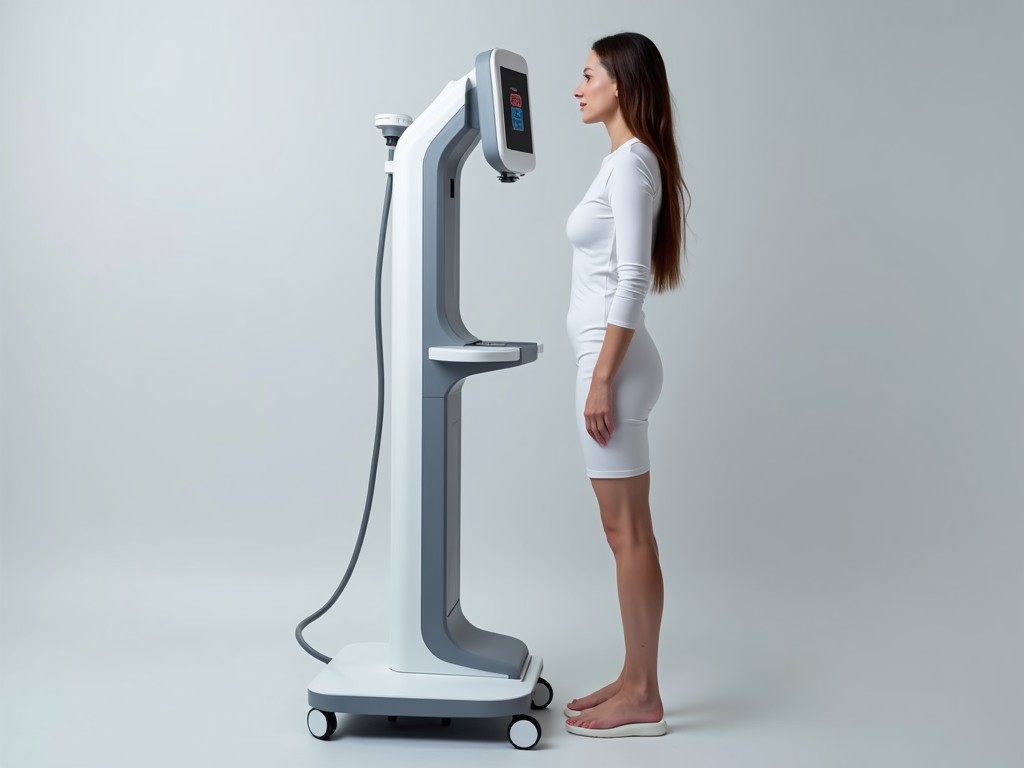
Wholesale Body Composition Testing Machine
A body composition testing machine quantifies fat mass, lean mass, total body water, and bone mineral content using multi‑frequency bioelectrical impedance analysis (MF‑BIA). It sends low‑level
Inquire NowWholesale Body Composition Testing Machine
A body composition testing machine quantifies fat mass, lean mass, total body water, and bone mineral content using multi‑frequency bioelectrical impedance analysis (MF‑BIA). It sends low‑level alternating currents through the torso and limbs, measuring impedance at several frequencies to separate intracellular and extracellular fluid compartments.
MF‑BIA applies currents from 1 kHz to 1000 kHz; low frequencies predominantly traverse extracellular water, while higher frequencies penetrate cell membranes, providing data on intracellular water. By fitting impedance spectra to a Cole‑Cole model, the device estimates phase angle, resistance, and reactance for each segment. The resulting outputs include percent body fat, fat‑free mass, basal metabolic rate, and visceral fat level.
Each unit is factory‑calibrated against dual‑energy X‑ray absorptiometry (DXA) reference scans, with a typical root‑mean‑square error of ≤1.5 % for fat‑mass estimation. Ongoing field verification can be performed using a supplied phantom resistor network that simulates known impedance values.
The enclosure is molded from impact‑resistant ABS polymer with a UL‑94 V‑0 flame rating, while electrodes are made of stainless‑steel (316L) plated with silver‑chloride to ensure stable contact resistance. Internal circuitry conforms to IEC 60601‑1 safety standards for medical electrical equipment, including isolation barriers and leakage current limits below 10 µA. The device operates reliably from 5 °C to 40 °C and tolerates relative humidity up to 85 % non‑condensing.
| Parameter | Typical Value | Unit |
|---|---|---|
| Measurement Method | Multi‑frequency Bioelectrical Impedance Analysis (MF‑BIA) | |
| Frequency Range | 1 kHz – 1000 kHz | |
| Number of Electrodes | 8 (tetrapolar configuration) | |
| Measurement Sites | Whole body (hand‑to‑foot); optional segmental (arm‑leg) | |
| Output Parameters | Fat mass, Lean mass, Total body water, Bone mineral content, Visceral fat, Basal metabolic rate, Phase angle | |
| Power Supply | 100‑240 V AC, 50/60 Hz, 30 VA | |
| Dimensions (W×D×H) | 350 mm × 260 mm × 110 mm | mm |
| Weight | 4.2 kg | kg |
| Operating Temperature | 5 °C – 40 °C | °C |
| Data Interface | USB‑C, optional Bluetooth LE |
Fitness centers use the machine to track member progress and tailor training programs, relying on segmental fat‑free mass readings to identify muscular imbalances. Clinical settings employ it for nutritional assessment, monitoring edema in dialysis patients, and pre‑operative risk stratification, where changes in extracellular water fraction guide fluid‑management decisions. Research laboratories value the high‑frequency impedance data for studying cellular membrane integrity and metabolic responses to interventions. Corporate wellness programs benefit from rapid, non‑invasive screening that can be deployed in office health fairs without requiring specialized technician training.
- Segmental analysis provides separate readings for trunk, arms, and legs.
- Touch‑screen interface with guided measurement protocol reduces user error.
- Built‑in memory stores up to 10,000 test records exportable via CSV.
- Automatic electrode impedance check alerts when contact quality falls below threshold.
- Firmware supports OTA updates for algorithm improvements and language packs.
Electrode size and spacing can be adjusted to accommodate pediatric or bariatric patient ranges, with optional larger surface pads for increased signal stability. Software language packs and report templates are configurable to match local regulatory requirements or corporate branding. Enclosure color, mounting brackets, and wall‑mount kits are available upon request to suit installation environments ranging from gym floors to clinic walls.
Each machine undergoes a 48‑hour burn‑in cycle at elevated temperature to detect early‑life component failures, followed by functional verification of impedance accuracy across the full frequency spectrum. Final inspection includes leakage current measurement, electrode continuity test, and visual inspection of enclosure integrity under 10× magnification. Documentation of calibration traceability to national standards is supplied with every unit, supporting audit trails for ISO‑9001 and ISO‑13485 quality systems.
Frequently Asked Questions
Can the measurement sites be customized for segmental vs whole‑body analysis?
Yes. The device ships with standard hand‑to‑foot electrodes for whole‑body assessment. Optional limb‑specific cuffs enable segmental analysis of arms, legs, and trunk, allowing users to switch modes via the software menu.
What information is required before receiving a quotation?
To prepare an accurate quote we need the intended application (e.g., fitness, clinical, research), required measurement mode (whole‑body or segmental), any customization requests such as electrode size, enclosure color, or language packs, and the desired quantity for wholesale pricing.
Which materials are available for the enclosure and electrodes?
The standard enclosure is impact‑resistant ABS polymer with a UL‑94 V‑0 rating. Electrodes are fabricated from 316L stainless steel with a silver‑chloride coating. Alternative enclosure colors and antimicrobial electrode finishes are offered as options.
How is the device protected during export shipment?
Units are packed in double‑wall corrugated cartons with interior foam inserts that immobilize the machine and accessories. Each carton is sealed with moisture‑resistant tape and marked with handling symbols. For bulk orders, palletization with stretch‑wrap and corner protectors is provided to meet ISTA‑3A standards.