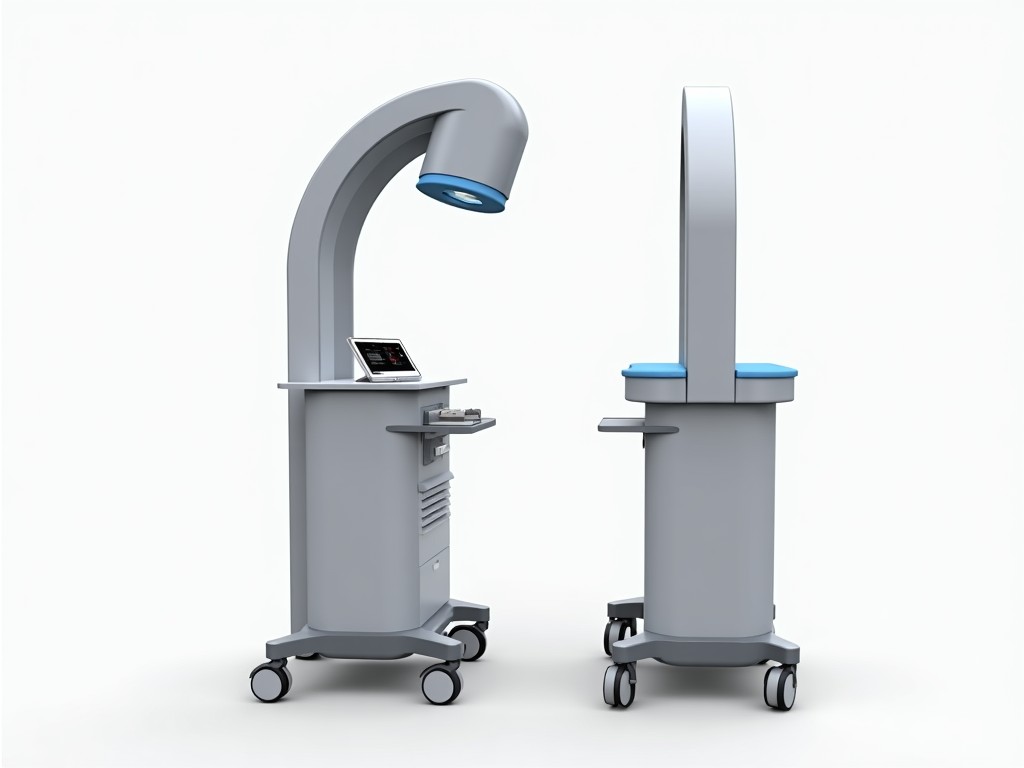
Ultrasound Body Fat Analyzer Manufacturer
An ultrasound body fat analyzer estimates subcutaneous fat thickness by transmitting short ultrasonic pulses into tissue and measuring the echo return time from the fat‑muscle interface. The device
Inquire NowUltrasound Body Fat Analyzer – Industrial Manufacturer
An ultrasound body fat analyzer estimates subcutaneous fat thickness by transmitting short ultrasonic pulses into tissue and measuring the echo return time from the fat‑muscle interface. The device processes the time‑of‑flight and signal attenuation to derive a thickness value, which is then converted to body‑fat percentage using validated population equations.
Typical transducers operate in the 1–5 MHz range with piezoelectric composite elements arranged in a linear array. Electronic beamforming allows adjustable focal depth, while the housing is sealed to IP65 standards for dust and water resistance, enabling reliable operation in gym, clinic, or field environments.
Technology Principle
Ultrasonic waves travel through soft tissue at an average speed of approximately 1540 m/s. When the wave encounters the interface between adipose tissue and underlying muscle, a portion of the energy reflects back to the transducer. The round‑trip time of this echo, corrected for the known propagation speed, yields the fat layer thickness.
Because acoustic attenuation differs between fat and lean tissue, the analyzer measures the amplitude reduction of both the transmitted and reflected signals. Applying an attenuation‑compensation algorithm improves thickness accuracy, especially for subjects with varying hydration levels or tissue density.
Key Specifications
| Parameter | Typical Value | Notes |
|---|---|---|
| Measurement Sites | Triceps, abdomen, thigh, calf | configurable via software |
| Ultrasonic Frequency | 1–5 MHz (adjustable in 0.5 MHz steps) | determines penetration depth and resolution |
| Penetration Depth | up to 30 mm | sufficient for subcutaneous fat measurement in most adult populations |
| Thickness Resolution | 0.1 mm | enables detection of small changes over time |
| Repeatability (SD) | ≤0.3 mm | based on 10 consecutive measurements on a phantom |
| Measurement Time | <2 seconds per site | includes signal acquisition and processing |
| Power Consumption | <0.5 W (average) | allows >8 hours continuous operation on a standard Li‑ion battery |
| Operating Temperature | 0 °C to 45 °C | suitable for indoor and outdoor use |
| Interface | Bluetooth 5.0, USB‑C, optional analog output | facilitates data transfer to mobile apps or hospital information systems |
| Dimensions | 120 mm × 70 mm × 25 mm (L×W×H) | handheld form factor |
| Weight | 280 g (including battery) | lightweight for repeated use |
Typical Applications
In fitness and wellness centers, the analyzer provides repeatable, non‑invasive tracking of subcutaneous fat changes, allowing trainers to adjust programs based on objective data rather than subjective visual assessment.
Clinical research studies benefit from the device’s portability and lack of ionizing radiation, enabling longitudinal body‑composition monitoring in large cohorts without the logistical constraints of DXA or MRI scanners.
Occupational health programs use the analyzer to assess workforce health risks associated with adiposity, supporting ergonomic interventions and preventive care plans while maintaining worker comfort and privacy.
Customization & Integration
OEM customers can select transducer center frequency, number of elements, and array geometry to match specific measurement depth and resolution targets. The analog front‑end gain and sampling rate are adjustable through firmware, allowing optimization for different tissue types or measurement protocols.
Output interfaces include Bluetooth Low Energy for wireless smartphone apps, USB‑C for direct PC connection, and an optional 0‑5 V analog voltage stream for integration with existing data‑acquisition systems. Enclosure materials range from medical‑grade ABS to stainless‑steel housings for harsh‑environment use.
A software development kit (SDK) provides access to raw echo data, thickness calculations, and calibration routines, enabling partners to embed the analyzer into proprietary health‑monitoring platforms or wearable ecosystems.
Quality Assurance
Each production lot undergoes design verification that includes acoustic performance testing across the specified frequency range, temperature cycling from –20 °C to +60 °C, and humidity exposure to confirm IP65 sealing integrity.
Transducer elements are inspected for resonance frequency deviation and coupling uniformity using laser interferometry. The assembled device is subjected to drop‑testing from 1 m onto a concrete surface to validate mechanical robustness.
Before shipment, every unit is calibrated against a reference phantom with known fat‑equivalent thickness; the calibration factor is stored in non‑volatile memory and can be re‑verified by the user via a supplied verification kit.
Frequently Asked Questions
Can the measurement sites be customized for specific populations? Yes, the software allows users to define custom site locations and adjust the algorithm’s population‑specific equations; contact our engineering team for details.
What information is required before quotation? Provide the desired measurement frequency range, number of channels, output interface preferences, and any environmental constraints (e.g., temperature, ingress protection). reach out to us to start the discussion.
What materials are available for the enclosure? Options include medical‑grade ABS, polycarbonate‑ABS blend, and stainless‑steel grade 316L; material selection influences weight, chemical resistance, and cost. ask for a material data sheet.
How is quality inspected? Each unit undergoes acoustic performance verification, temperature cycling, and IP65 sealing tests; documentation of test results is available upon request.
What is the typical production lead time? Lead time depends on order volume and customization level; standard configurations typically ship within 4‑6 weeks after receipt of purchase order, while fully customized units may require 8‑10 weeks.
Contact our engineering team to discuss your specific measurement requirements