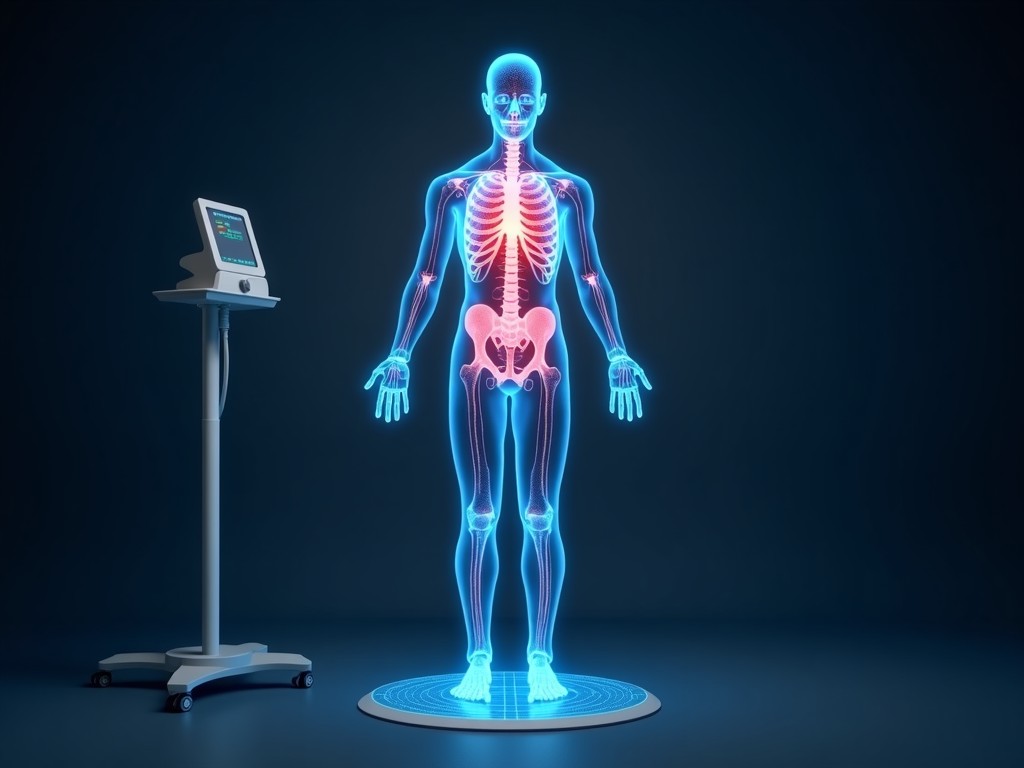
Odm Medical Body Composition Analyzer
An ODM medical body composition analyzer is a multi‑frequency bioelectrical impedance analysis (BIA) system that estimates fat mass, lean mass, total body water, and visceral fat level. It is
Inquire NowODM Medical Body Composition Analyzer
An ODM medical body composition analyzer is a multi‑frequency bioelectrical impedance analysis (BIA) system that estimates fat mass, lean mass, total body water, and visceral fat level. It is engineered for integration into clinical workflows, wellness centers, and research labs where hardware and software can be tailored to specific diagnostic or operational needs.
Technical Overview
The device applies alternating currents at frequencies ranging from 5 kHz to 500 kHz through tactile electrodes. By measuring impedance magnitude and phase at each frequency, the system separates extracellular and intracellular water, enabling segmental and whole‑body composition modeling.
A typical configuration uses eight electrodes (hand‑to‑hand, foot‑to‑foot) with optional hand‑to‑foot arrays for segmental analysis. Measurement cycles are completed in ≤20 seconds, and results are displayed on a touchscreen or transmitted via digital interfaces.
Key Specifications
| Parameter | Typical Value / Range | Notes |
|---|---|---|
| Measurement Principle | Multi‑frequency Bioelectrical Impedance Analysis (BIA) | — |
| Frequencies | 5, 50, 100, 250, 500 kHz (configurable) | User‑selectable via software |
| Electrode Configuration | 8‑point tactile (hand‑hand, foot‑foot); optional segmental | Interchangeable sets |
| Measurement Time | ≤20 seconds per scan | Includes data processing |
| Weight Capacity | 150–300 kg | Dependent on load cell selection |
| Height Input Range | 100–220 cm | Manual entry or sonar |
| Age Range | 5–99 years | — |
| Body Fat % Range | 0–80 % | Derived from impedance model |
| Total Body Water Range | 0–70 L | — |
| Visceral Fat Level | 1–30 (AU) | Arbitrary units |
| Accuracy vs. DXA | Mean absolute error ≈1.5 % body fat, ±0.5 L TBW | Typical validation data |
| Power Supply | 100–240 V AC, 50/60 Hz, 40 VA | — |
| Output Interfaces | USB, RS‑232, HL7, Wi‑Fi (optional) | Configurable per order |
| Operating Temperature | 10–40 °C | — |
| Storage Temperature | –20–60 °C | — |
| Dimensions (W×D×H) | 350 mm × 300 mm × 110 mm (typical) | Customizable |
| Weight | 4.5 kg (typical) | Depending on housing |
Typical Applications
In hospitals, the analyzer assists with nutritional assessment, monitoring fluid status in dialysis or heart‑failure patients, and preoperative risk stratification. Clinicians rely on repeatable segmental data to track changes in lean mass over therapy cycles.
Fitness and wellness centers use the device to provide personalized training programs based on segmental fat and lean distribution. The quick measurement cycle supports high‑throughput screening without disrupting member flow.
Research laboratories employ multi‑frequency BIA to study hydration shifts, sarcopenia progression, and metabolic syndrome. The ODM model allows integration with electronic medical records (EMR) or laboratory information systems (LIS) via HL7 or custom APIs, reducing manual transcription.
Customization Options (ODM)
- Electrode configuration – hand‑hand, foot‑foot, or segmental hand‑to‑foot arrays
- Housing material – medical‑grade ABS (standard), antimicrobial‑coated ABS, powder‑coated aluminum, or stainless‑steel Grade 304
- Display – 7‑inch touchscreen LCD, monochrome LED panel, or no display for OEM integration
- Software – language selection, custom reporting formats, HL7/MDCP interface, Wi‑Fi or Ethernet connectivity
- Mounting options – tabletop base, mobile cart with lockable wheels, or wall‑mount bracket
- Calibration kit – traceable multi‑compartment phantom with verification software
Quality Assurance and Testing
Each unit undergoes a functional test of impedance magnitude and phase at all frequencies using precision resistors traceable to national standards. Leakage current and dielectric strength are measured per IEC 60601‑1 to verify patient safety.
Calibration is performed with a multi‑compartment phantom that mimics known fat‑lean‑water ratios; the resulting coefficients are stored in firmware and verified against a reference DXA scan.
Environmental validation includes temperature cycling (‑20 °C to 60 °C), humidity exposure (10%–95% RH non‑condensing), and vibration testing to ensure reliability during transport and bedside use.
Final inspection comprises visual inspection, label and barcode verification, firmware checksum validation, and a functional demo scan before packaging.
Frequently Asked Questions
Yes. The ODM version supports interchangeable electrode sets for hand‑hand, foot‑foot, or segmental hand‑to‑foot configurations. The measurement software automatically selects the appropriate impedance model based on the attached electrodes.
Provide the target weight capacity, desired frequency set, housing material preference, required interfaces (USB, HL7, Wi‑Fi), estimated annual volume, and any regulatory destination (e.g., CE, FDA). This enables us to tailor the hardware, firmware, and safety testing scope.
Standard options include medical‑grade ABS with optional antimicrobial coating, powder‑coated aluminum for added durability, and stainless‑steel Grade 304 for harsh‑environment or clean‑room applications.
Each unit receives a 100% functional test of impedance accuracy, a high‑potential dielectric test, and a visual inspection. A sample lot undergoes accelerated life testing per IEC 60601‑1‑11 to verify long‑term reliability.
Contact for Inquiry
To discuss your specific ODM requirements, request a detailed specification sheet, or arrange a sample unit, please contact our engineering team.
Contact Engineering Team