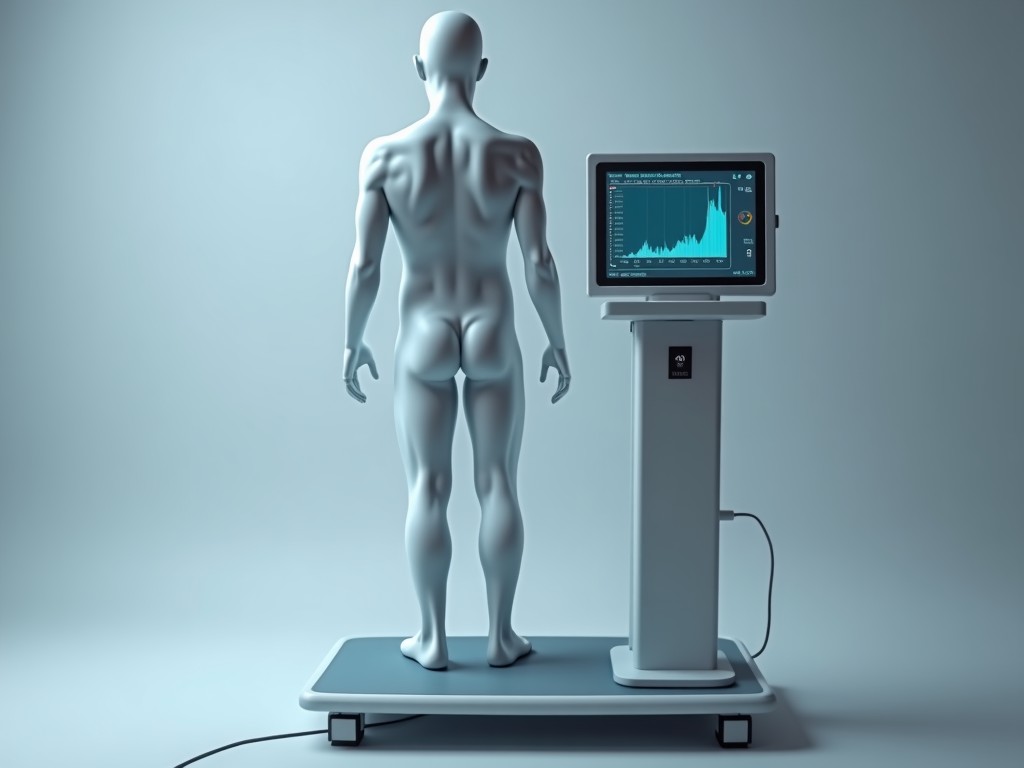
Odm Body Fat Analyzer With Printer
The device integrates bioelectrical impedance analysis (BIA) with an onboard thermal printer to deliver immediate, printable body composition reports at the point of measurement. Intended for
Inquire NowODM Body Fat Analyzer with Printer
The device integrates bioelectrical impedance analysis (BIA) with an onboard thermal printer to deliver immediate, printable body composition reports at the point of measurement.
Overview
Intended for industrial wellness screening, corporate health programs, and fitness facilities where operators require a hard‑copy result without reliance on external computers or network connectivity.
Technical Specifications
| Parameter | Typical Value |
|---|---|
| Measurement Principle | Bioelectrical Impedance Analysis (BIA) |
| Measurement Frequencies | 5 kHz, 50 kHz, 250 kHz (multi‑frequency) |
| Body Fat Range | 3 % – 50 % (display resolution 0.1 %) |
| Repeatability (σ) | ±0.3 % body fat under standardized conditions |
| Printer Type | Direct thermal line printer, 58 mm width, 200 dpi |
| Print Speed | 50 mm/s (≈8 lines/s) |
| Power Input | 100‑240 V AC, 50/60 Hz, 15 VA |
| Operating Temperature | 10 °C – 40 °C, 20 % – 80 % RH non‑condensing |
| Dimensions (W×D×H) | 210 mm × 150 mm × 65 mm |
| Weight | 1.2 kg (including printer roll) |
How It Works
The analyzer sends a low‑amplitude alternating current through the subject’s hands and feet; the resulting impedance is measured at multiple frequencies to estimate extracellular and intracellular water, from which fat‑free mass and body fat percentage are derived using validated regression equations.
Upon completion, the microprocessor formats the results and drives the thermal printer to produce a concise report that includes body fat %, visceral fat level, skeletal muscle mass, and basal metabolic rate.
Key Features
- Multi‑frequency BIA improves accuracy across diverse body types.
- Integrated thermal printer eliminates need for external PC or label printer.
- Onboard memory stores up to 500 measurement sets for later retrieval.
- Low‑power standby mode (<0.5 W) extends operational life in continuous‑use environments.
- USB‑type C port enables firmware updates and data export when required.
Applications
- Corporate wellness screening – provides immediate printable feedback to employees during health fairs.
- Fitness center member onboarding – delivers a tangible baseline report that can be filed or given to the client.
- Clinical pre‑assessment – supports rapid body composition checks prior to surgical or rehabilitation programs.
- Sports team monitoring – enables coaches to track changes in muscle and fat over training cycles with hard‑copy logs.
Customization Options
- Selection of measurement parameters (e.g., addition of phase angle or total body water).
- Printer language and character set (ESC/POS, CPCL, or ZPL) to match existing label systems.
- Housing material choices (ABS, polycarbonate, or antimicrobial‑treated polymer).
- Interface configuration (USB, RS‑232, or Bluetooth) for data integration with hospital information systems.
- Calibration schedule and certification documentation tailored to industry‑specific quality standards.
Quality Assurance
Each unit undergoes incoming inspection of load cells, impedance circuitry, and print head functionality before assembly.
Functional testing includes verification of measurement repeatability across a calibrated phantom set and validation of print clarity under varying temperature and humidity conditions.
Final audit confirms labeling, firmware version, and compliance with electrical safety norms (IEC 60601‑1‑classification as applicable).
FAQ
Can the measurement electrodes be replaced?
Yes, the hand and foot electrodes are modular and can be swapped with compatible spare parts supplied by the manufacturer.
What information is required before quotation?
Required details include intended measurement volume, desired parameters, printer language, housing material, and any interface or certification needs.
How is quality inspected for bulk orders?
Statistical process control is applied; a sample from each production lot is subjected to full functional and environmental testing before release.
What packaging methods are available for export?
Standard packaging consists of anti‑static inner wrapping, corrugated carton with corner protection, and palletization for containerized shipments.
What is the typical production lead time?
Lead time ranges from 4 to 6 weeks after receipt of final specifications, depending on order volume and customization complexity.
For further details or to request a quotation tailored to your project, please contact our technical team.