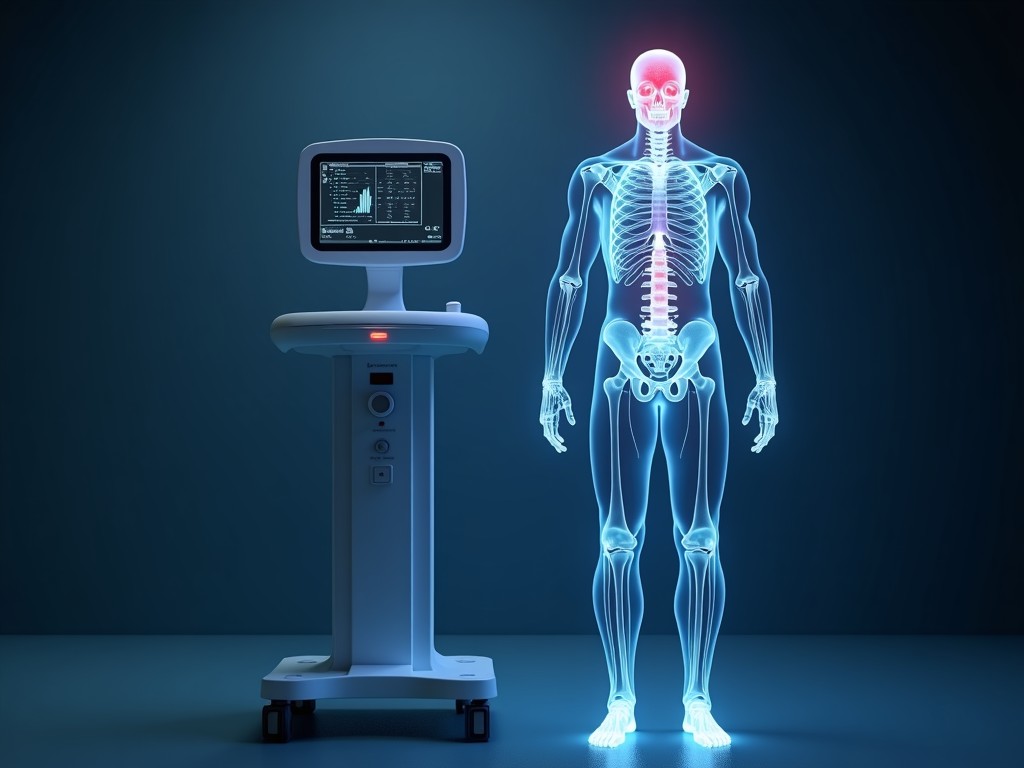
Odm Body Composition Analysis Machine
The device measures body composition using multi-frequency bioelectrical impedance analysis (MF-BIA). It sends low‑amplitude alternating currents through segmental electrodes placed on hands and
Inquire NowODM Body Composition Analysis Machine
The device measures body composition using multi-frequency bioelectrical impedance analysis (MF-BIA). It sends low‑amplitude alternating currents through segmental electrodes placed on hands and feet. The resulting impedance vectors are used to calculate extracellular water, intracellular water, fat‑free mass, and fat mass.
Measurement Principle and Technology
The system operates at five discrete frequencies ranging from 1 kHz to 1 MHz.
Each frequency penetrates tissue to a different depth, enabling separate estimation of intracellular and extracellular fluid compartments.
Eight tactile electrodes (four on each hand and foot) provide segmental readings for the trunk, arms, and legs.
Technical Specifications
| Parameter | Typical Value | Notes |
|---|---|---|
| Measurement technology | Multi‑frequency bioelectrical impedance analysis (MF‑BIA) | Standard |
| Frequency range | 1 kHz – 1 MHz (5 frequencies) | Selected for multi‑compartment modeling |
| Number of electrodes | 8 (segmental) | Hand‑to‑foot configuration |
| Measurement time | 10 s – 5 min (protocol selectable) | Depends on selected analysis depth |
| Repeatability (CV%) | < 1 % (fat‑free mass) | Measured on same subject under stable conditions |
| Accuracy vs. DXA | R² ≥ 0.94 (fat mass) | Based on Bland‑Altman limits of agreement ±2 % |
| Output interfaces | USB‑CDC, Bluetooth LE, RS‑232 (configurable) | Factory‑set per order |
| Power consumption | < 2 W (idle), < 5 W (measurement) | DC 5 V input |
| Operating temperature | –10 °C to 45 °C | Relative humidity 10‑90 % non‑condensing |
| Dimensions (W×H×D) | 120 mm × 80 mm × 30 mm | Enclosure only, excludes cable strain relief |
| Weight | 250 g | Includes internal battery option |
Typical Applications in Industry
In fitness facilities, segmental fat‑free mass readings enable trainers to assess muscle imbalances between limbs, guiding personalized strength programs.
Clinical settings use the device’s extracellular‑to‑intracellular water ratio to monitor edema progression in renal or cardiac patients.
Research labs rely on the high repeatability (CV < 1 %) to track longitudinal changes in body composition during intervention studies.
Customization Options for OEM Integration
OEMs can request alternative electrode materials such as stainless‑steel snap‑on or conductive rubber pads to match ergonomic design constraints.
Firmware can be tailored to output data via USB‑CDC, Bluetooth LE, or RS‑232, with selectable measurement protocols (e.g., quick 10‑second scan or full 5‑minute segmental analysis).
Enclosure dimensions and mounting interfaces are adjustable to integrate the measurement module into existing scales, treadmill consoles, or wall‑mounted kiosks.
Quality Control and Validation
Each unit undergoes a two‑point impedance calibration using precision resistors traceable to national standards before leaving the factory.
Batch testing includes a Bland‑Altman analysis against dual‑energy X‑ray absorptiometry (DXA) on a diverse cohort to verify limits of agreement within ±2 % fat mass.
Incoming electronic components are screened for tolerance and temperature coefficient to ensure measurement stability across the specified –10 °C to 45 °C operating range.
FAQ
- Can the electrode spacing be adjusted for different subject sizes? Yes, adjustable straps accommodate limb circumferences from 18 cm to 45 cm while maintaining consistent contact pressure.
- What information is required before quotation? Required details include desired measurement range, output interface preferences, enclosure constraints, and expected annual volume.
- How is quality inspected? Every device receives a two‑point impedance calibration, followed by functional testing and a Bland‑Altman comparison to DXA reference data.
Inquiry and Support
To discuss specific OEM requirements or request a technical datasheet, please contact our engineering team.
Request a quote