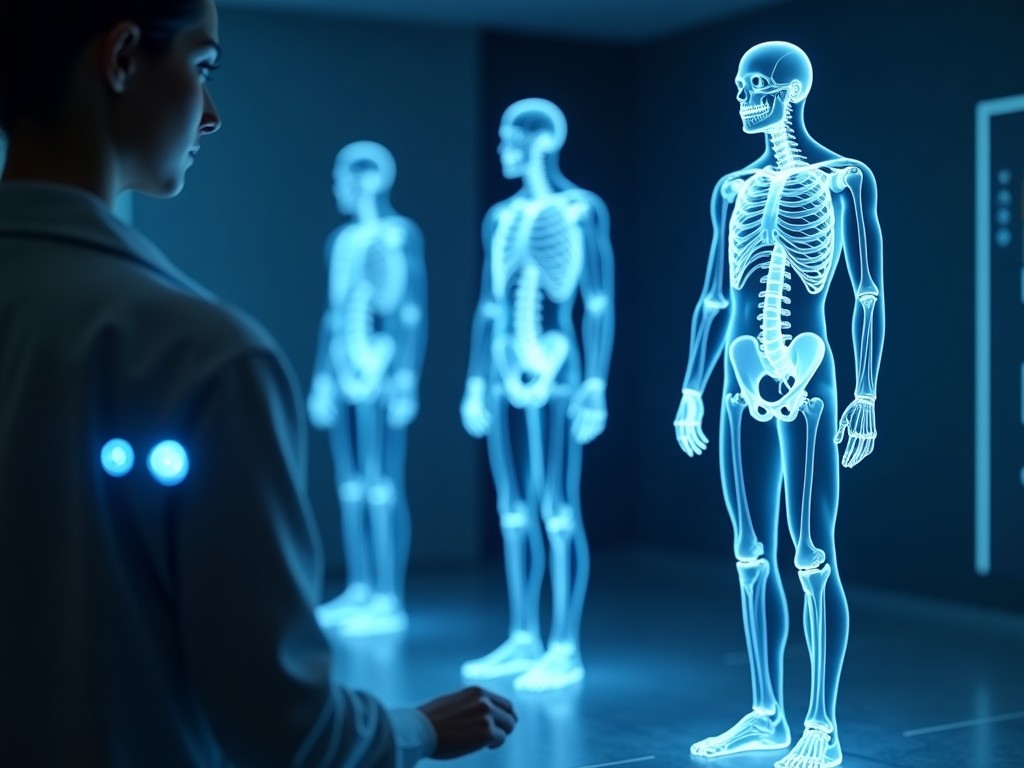
Odm Advanced Body Composition Analyzer
This instrument measures body composition by sending low‑amplitude alternating currents through the torso and limbs and analyzing the resulting impedance spectra. Multi‑frequency operation (typically
Inquire NowODM Advanced Body Composition Analyzer
This instrument measures body composition by sending low‑amplitude alternating currents through the torso and limbs and analyzing the resulting impedance spectra. Multi‑frequency operation (typically 5 kHz, 50 kHz, 250 kHz) enables separate estimation of extracellular water, intracellular water, and total body water, from which fat‑free mass and fat mass are derived.
Measurement Principle and Technical Specifications
The device uses eight‑point tactile electrodes (hand‑to‑hand and foot‑to‑foot) to ensure current paths traverse both upper and lower body segments. Excitation currents are kept below 0.8 mA rms to satisfy IEC 60601‑2‑26 safety limits. Voltage sensing is performed with a 24‑bit delta‑sigma ADC, providing a resolution of 0.01 Ω.
Impedance is measured at five frequencies: 5 kHz, 50 kHz, 100 kHz, 200 kHz, 500 kHz. The raw data are processed with a Cole‑Cole model to extract intracellular and extracellular resistance values. Typical repeatability (coefficient of variation) for total body water is ≤1.5 % under standardized fasting conditions.
Typical Performance Values
| Parameter | Typical Value | Condition / Note |
|---|---|---|
| Total Body Water (TBW) range | 20 – 70 L | Adults, BMI 18‑35 |
| Fat Mass (FM) accuracy | ±1.5 % FM | Compared to DXA reference |
| Impedance measurement resolution | 0.01 Ω | 24‑bit ADC |
| Excitation current | ≤0.8 mA rms | Per IEC 60601‑2‑26 |
| Measurement time | < 10 s | Stable reading after electrode contact |
Applications in Industrial and Commercial Settings
Beyond consumer fitness devices, the analyzer is integrated into corporate wellness programs where longitudinal tracking of employee hydration and lean mass supports occupational health interventions. In clinical rehabilitation centers, segmental impedance data help clinicians monitor muscle atrophy or edema progression in patients undergoing physiotherapy.
Research laboratories use the multi‑frequency output to investigate fluid shifts during dialysis or to validate novel hydration biomarkers. The ODM form factor allows integration into mobile health kiosks, where the device can be housed in a rugged enclosure with optional battery operation for field studies.
Customization Options (ODM)
- Enclosure material: ABS polymer, powder‑coated aluminum, or medical‑grade stainless steel.
- Electrode type: disposable snap‑on, reusable stainless steel, or textile‑integrated dry electrodes.
- Communication interfaces: USB‑C, Bluetooth 5.0, Wi‑Fi, or RS‑485 for PLC integration.
- Software: configurable data export (CSV, HL7), multi‑language UI, optional cloud‑API for remote monitoring.
- Calibration: factory‑set with traceable saline standards; user‑adjustable gain available via service menu.
Quality Control Philosophy
Each unit undergoes a three‑stage test: (1) electrical safety verification according to IEC 60601‑1, (2) impedance linearity check using precision resistor networks across the full frequency sweep, and (3) biological validation with a panel of volunteers whose composition is measured by dual‑energy X‑ray absorptiometry. Only devices meeting ≤2 % error on fat‑mass versus DXA proceed to final packaging.
Frequently Asked Questions
Yes – the electrode geometry is a customizable mechanical parameter; alternative pads or adjustable straps are available upon request.
Typical inputs include target measurement volume (units per year), desired electrode type, enclosure material, communication interface, and any regulatory certifications needed for the destination market.
Every lot receives automated impedance linearity testing, a visual inspection of electrode contacts, and a final functional test using a reference phantom with known resistance values.
Units are placed in anti‑static foam inserts inside double‑wall corrugated cartons, with corner protectors and humidity‑indicator cards for long‑distance transport.
To discuss how this analyzer can be tailored to your specific measurement workflow, please contact our engineering team.
Request Technical Consultation