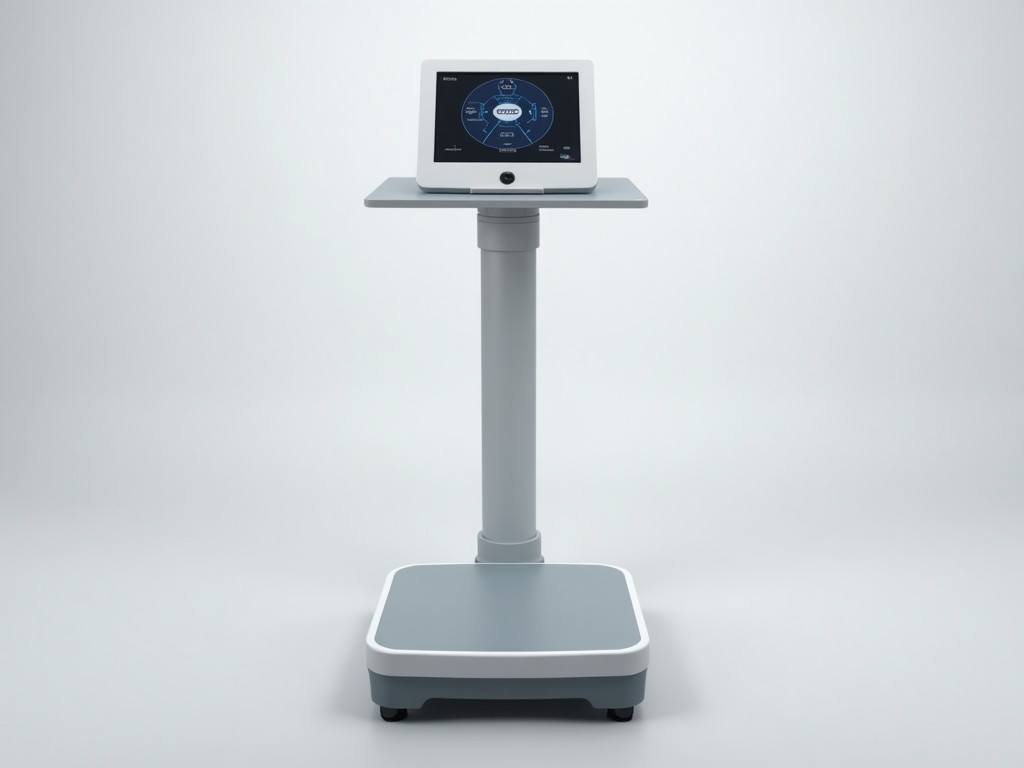
Custom Scale Body Fat Analyzer Factory
A body fat analyzer integrated into a weighing scale combines bioelectrical impedance analysis (BIA) with precise load‑cell measurement to provide simultaneous weight and body composition data. In an
Inquire NowCustom Scale Body Fat Analyzer Factory
A body fat analyzer integrated into a weighing scale combines bioelectrical impedance analysis (BIA) with precise load‑cell measurement to provide simultaneous weight and body composition data. In an industrial setting, the device must deliver repeatable results across a wide range of user masses, tolerate frequent cleaning, and allow OEMs to embed the electronics into custom housings or platforms.
Design and Measurement Principles
The scale uses four‑point load cells calibrated to 0.1 kg resolution, with a full‑scale capacity typically ranging from 150 kg to 300 kg depending on the model. The BIA subsystem applies a low‑amplitude, multi‑frequency alternating current (usually 5 kHz, 50 kHz, and 500 kHz) through electrodes embedded in the platform surface.
Impedance values at each frequency are processed using empirically derived equations that estimate extracellular water, intracellular water, and consequently fat‑free mass. Temperature compensation circuitry maintains measurement stability within ±0.5 % across operating temperatures of 10 °C to 40 °C.
Key Technical Specifications
| Parameter | Typical Value / Customizable |
|---|---|
| Load‑cell capacity | 150 kg – 300 kg (selectable per OEM) |
| Weight resolution | 0.1 kg |
| BIA frequencies | 5 kHz, 50 kHz, 500 kHz (configurable) |
| Impedance measurement range | 100 Ω – 1000 Ω |
| Output interfaces | USB, UART, Bluetooth 5.0 (optional) |
| Operating temperature | 10 °C – 40 °C |
| Housing material | ABS, PC‑ABS, or stainless‑steel frame (per project) |
| Power supply | 5 V DC, 2 A (adapter) or internal Li‑ion 3.7 V 2000 mAh |
Customization Options
- Platform dimensions: length 300 mm – 500 mm, width 300 mm – 400 mm, thickness 20 mm – 40 mm.
- Electrode pattern: stainless‑steel pads, printed conductive ink, or removable snap‑on contacts.
- Load‑cell type: shear beam, bending beam, or double‑ended shear beam for high‑capacity versions.
- Firmware: selectable measurement modes (athletic, pediatric, geriatric), user‑profile storage capacity up to 200 records.
- Enclosure ingress protection: IP65 for wash‑down environments, achieved with silicone gaskets and sealed connectors.
- Calibration accessories: certified reference weights, software tools for field verification.
Applications in Industry
Fitness equipment manufacturers integrate the analyzer into treadmills and multi‑station strength consoles to give users immediate feedback on training efficacy.
Medical device OEMs embed the module in patient‑monitoring carts where periodic body‑composition tracking supports nutritional assessment and dialysis planning.
Corporate wellness programs utilize the scales in health‑kiosks; the ability to log data to a central server via Bluetooth or USB enables longitudinal studies without manual entry.
Manufacturing and Quality Control
Load cells undergo temperature cycling and overload testing to verify linearity within ±0.05 % of full scale. Each BIA board is inspected for electrode continuity and impedance measurement repeatability using a precision resistor network.
Finished units receive a three‑point calibration: zero load, mid‑scale (50 % capacity), and full scale, with results logged to a traceable database.
Statistical process control monitors key parameters such as load‑cell offset drift and BIA gain variation; corrective actions are triggered when CpK falls below 1.33.
Frequently Asked Questions
- Can the platform dimensions be changed?
- Yes. Length, width, and thickness are adjustable within the ranges listed in the Customization Options section; new tooling quotes are provided after receipt of a detailed drawing.
- What information is required before quotation?
- Target weight capacity, desired BIA frequency set, output interface preferences, housing material, ingress protection level, and expected annual volume.
- Which materials are available for the housing?
- ABS, PC‑ABS blends, and 304 stainless‑steel frames. Custom over‑molds or antimicrobial coatings can be arranged upon request.
- How is quality inspected?
- Each unit undergoes electrical safety testing (HI‑POT), load‑cell linearity verification, BIA repeatability checks, and visual inspection for electrode adhesion and sealing integrity.
- What packaging methods are available?
- Standard packaging includes anti‑static inner trays, corrugated master cartons with corner protectors, and palletizing for bulk shipments. Custom foam inserts or reusable crates are offered for high‑mix production.
- How are export shipments protected?
- Cartons meet ISTA 3A standards; desiccant packs and humidity indicators are added for sea‑freight containers to prevent condensation.
- What is the typical production lead time?
- Lead time ranges from 4 weeks for standard configurations to 8‑10 weeks for fully customized housings, assuming approved design files and material availability.
- How are samples arranged?
- Samples are shipped via express courier with pre‑paid duties; a sample unit includes a calibration certificate and user manual.
Request a Quote
To begin a custom project, provide your technical requirements and expected annual volume. Our engineering team will review the specifications and return a detailed quotation within two business days.