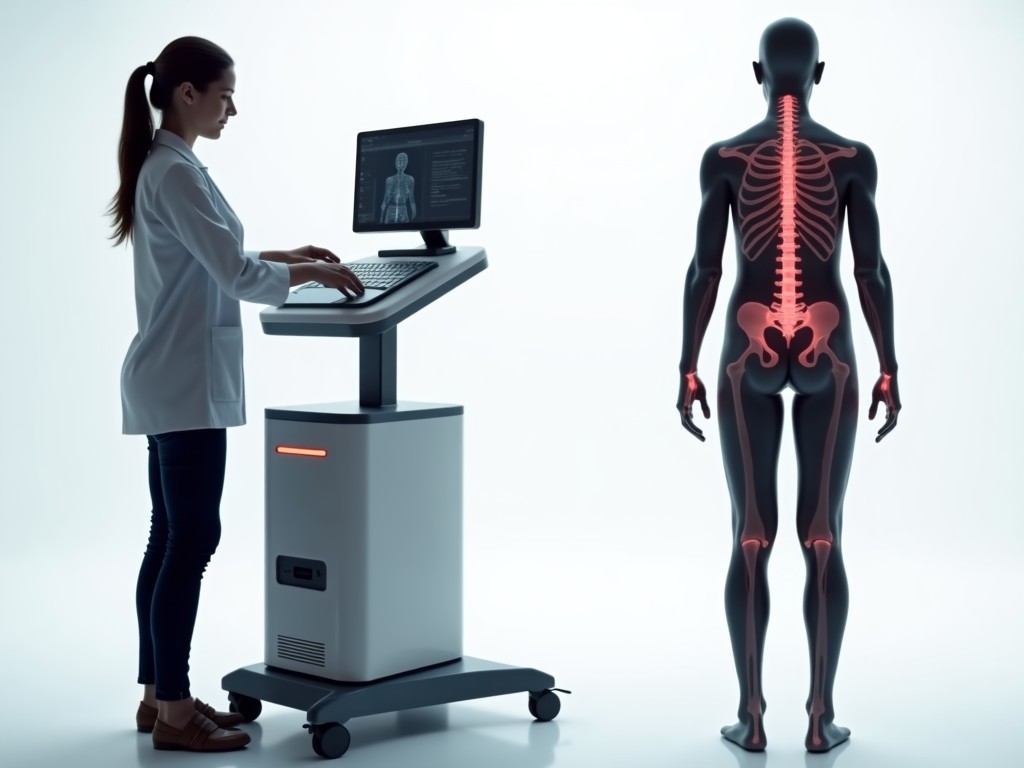
Custom Medical Body Composition Analyzer
A medical body composition analyzer measures the electrical impedance of body tissues to derive segmental and whole‑body composition metrics. Customization focuses on electrode geometry, measurement
Inquire NowCustom Medical Body Composition Analyzer
A medical body composition analyzer measures the electrical impedance of body tissues to derive segmental and whole‑body composition metrics.
Customization focuses on electrode geometry, measurement frequency range, and software outputs to match specific diagnostic protocols or research requirements.
Measurement Technology
The device applies a low‑amplitude alternating current through surface electrodes and records voltage drop across multiple frequencies.
By analyzing impedance magnitude and phase angle at each frequency, the system estimates extracellular water (ECW), intracellular water (ICW), and derived compartments such as fat‑free mass and fat mass.
Key Performance Parameters
| Parameter | Typical Value / Customizable |
|---|---|
| Measurement range | 0–500 Ω (typical) |
| Repeatability | ±0.5 % of reading (typical) |
| Sampling frequency | 50 Hz (standard) |
| Number of frequencies | 5–50 (configurable) |
| Electrode configuration | 8‑point tactile (standard) |
| Output parameters | fat mass, fat‑free mass, total body water, extracellular water, intracellular water, skeletal muscle mass, bone mineral estimate (selectable) |
| Power consumption | <5 W (typical) |
| Dimensions | 300 mm × 200 mm × 100 mm (customizable) |
| Weight | 2.5 kg (typical) |
Customization Options
Electrode geometry influences current distribution and thus the sensitivity to specific tissue layers; options include circular, rectangular, or custom‑molded shapes ranging from 20 mm to 80 mm diameter.
Housing material selection affects durability and cleaning compatibility; medical‑grade ABS withstands repeated disinfection with alcohol‑based agents, while stainless steel provides higher impact resistance for mobile units.
Software output can be configured to transmit raw impedance data, derived percentages, or HL7‑formatted messages for integration with hospital information systems.
Calibration options allow users to adjust reference values based on population‑specific norms or to validate against gold‑standard methods such as DXA.
- Electrode shape and size
- Cable length and connector type
- Housing material (medical‑grade ABS, stainless steel)
- Software interface (HL7, DICOM, custom API)
- Calibration protocols (factory, user‑adjustable)
- Mounting options (desktop cart, wall‑mount, handheld)
Typical Applications
In outpatient nutrition clinics, the analyzer provides rapid, non‑invasive tracking of fat‑free mass changes during weight‑management programs, enabling dietitians to adjust caloric prescriptions based on objective data.
For hemodialysis centers, segmental extracellular water measurements help identify fluid overload or depletion between sessions, supporting dry‑weight determination without reliance on weight alone.
Geriatric rehabilitation units use the device to detect early loss of skeletal muscle mass, facilitating timely intervention before functional decline.
Research laboratories benefit from the adjustable frequency set‑up to investigate intracellular water shifts during exercise recovery protocols.
Quality Assurance & Validation
Each unit undergoes a functional test where known impedance networks are connected to verify measurement accuracy across the full frequency spectrum.
Electrode surfaces are inspected for surface roughness and conductivity to ensure consistent current injection, with acceptance criteria of <0.1 Ω variation between units.
Software validation includes unit‑tested algorithms for impedance‑to‑composition conversion, benchmarked against reference data from dual‑energy X‑ray absorptiometry studies.
Integration & Interface
A standard USB‑C port provides plug‑and‑play connection to a host PC for configuration and data export, while an Ethernet jack enables network‑based storage in a PACS environment.
Optional wireless modules support real‑time transmission to mobile devices, allowing clinicians to retrieve results at the point of care without additional hardware.
The built‑in web server can serve a lightweight interface for remote configuration, reducing the need for dedicated software installations.
FAQ
- Can electrode configuration be customized? Yes, the number, layout, and size of electrodes can be tailored to match specific segmental analysis protocols or research setups.
- What information is needed for a quotation? Required details include desired measurement parameters, frequency range, electrode type, housing material, software interface, and any regulatory certifications required for the target market.
- What materials are available for the housing? Medical‑grade ABS, polycarbonate, and stainless steel are standard options; additional biocompatible polymers can be sourced upon request.
- How is measurement accuracy verified? Accuracy is confirmed by comparing analyzer output against reference methods (DXA, isotope dilution) using a set of validation subjects covering the intended BMI range.
- What packaging methods are used for shipping? Units are packed in double‑wall corrugated boxes with internal foam inserts, sealed with humidity‑indicating cards to protect electronics during transit.
- What is the typical production lead time? Lead time varies from 4 to 8 weeks depending on configuration complexity and current workload, with expedited options available for critical projects.