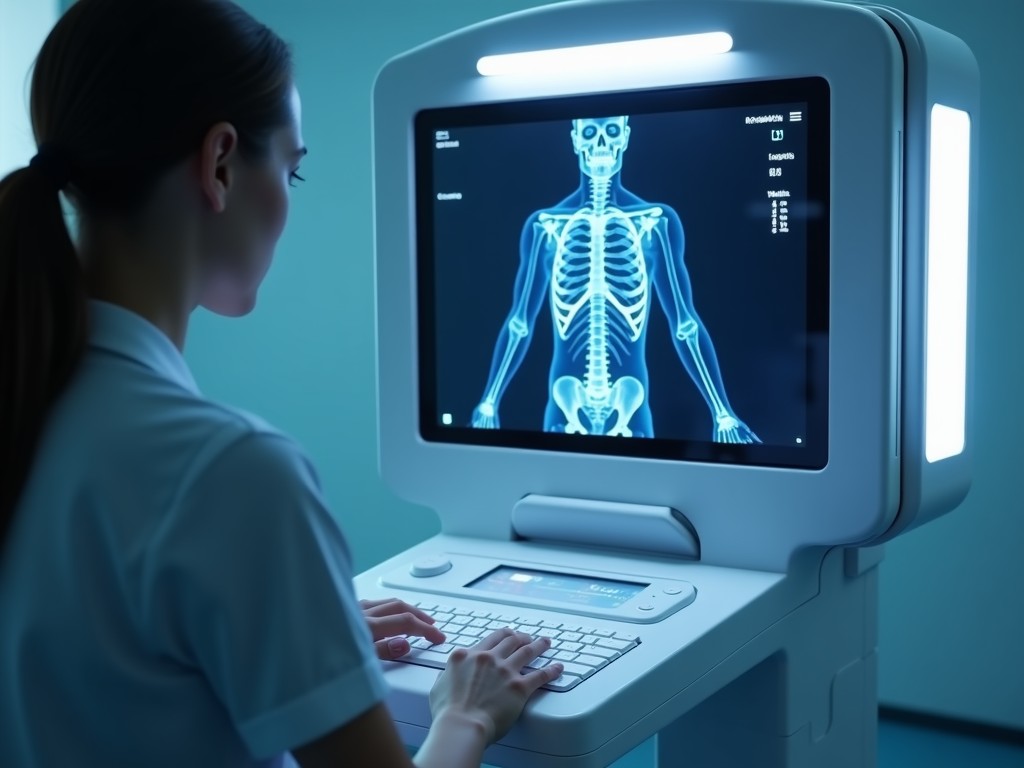
Custom Digital Body Composition Analyzer
A custom digital body composition analyzer measures bioelectrical impedance across multiple frequencies to estimate fat mass, lean mass, and total body water. Because electrode placement, housing
Inquire NowCustom Digital Body Composition Analyzer
A custom digital body composition analyzer measures bioelectrical impedance across multiple frequencies to estimate fat mass, lean mass, and total body water.
Because electrode placement, housing geometry, and signal‑processing algorithms affect measurement consistency, the analyzer can be adapted to specific population groups or equipment integration requirements.
Results are delivered via Bluetooth Low Energy or USB‑C as raw impedance values and derived metrics, enabling integration with health‑management software or research databases.
Technical Specifications
The analyzer’s core electronics are built around a 24‑bit ADC with programmable gain, allowing impedance measurement from 5 kHz to 500 kHz.
Key performance characteristics are summarized below; values can be adjusted to match project‑specific accuracy, size, or power constraints.
| Parameter | Typical Value / Customizable |
|---|---|
| Impedance Frequency Range | 5 kHz – 500 kHz (selectable bands) |
| Measurement Current | <100 µA rms ( IEC 60601‑2‑33 compliant ) |
| Resolution | 24‑bit ADC, effective resolution ~0.01 Ω |
| Repeatability (SD) | Typically ±0.4 % body fat under controlled conditions |
| Data Output | BLE 5.0, USB‑C (raw impedance, derived metrics) |
| Power Consumption | <2 W during measurement, <10 µA standby |
| Operating Temperature | 0 °C to 40 °C |
| Dimensions (L×W×H) | Customizable; typical 150 mm × 80 mm × 20 mm |
| Weight | Approx. 120 g (housing dependent) |
Customization Options
Mechanical, electrical, and firmware aspects are modular to simplify integration into OEM products or clinical workflows.
Typical customization axes include electrode configuration, enclosure dimensions, communication interfaces, and calibration reference points.
- Electrode layout: 4‑, 8‑, or 16‑segment arrays; material choices (stainless steel 316L, gold‑plated brass)
- Enclosure: ABS/PC blend, optional antimicrobial coating, IP‑rating up to IP65
- Communication: BLE, USB‑C, UART, or custom PCB connector
- Firmware: selectable calculation algorithms (BIA, MFBIA, segmental), user‑defined calibration tables
- Power: internal rechargeable Li‑ion, external DC input, or battery‑free passive version
Industrial Applications
In wellness centers, the analyzer provides rapid segmental assessments that support personalized training programs without the need for costly imaging.
For occupational health programs, repeated measurements track changes in hydration and lean mass, helping evaluate the effectiveness of ergonomic interventions.
Research laboratories benefit from the device’s open data format, which allows synchronization with motion‑capture or metabolic‑cart systems for longitudinal studies.
Quality Assurance & Calibration
Each unit undergoes a two‑point impedance verification using precision resistors traceable to national standards.
Firmware includes automatic temperature compensation and baseline drift correction, reducing measurement variance across ambient conditions.
Final validation compares analyzer output against dual‑energy X‑ray absorptiometry (DEXA) on a reference cohort, with adjustment factors stored in the device’s memory.
Next Steps
To discuss how the analyzer can be tailored to your specific application, provide your technical requirements and preferred integration timeline.
Our engineering team will respond with a feasibility study, cost estimate, and lead‑time estimate within two business days.
Request a Quote