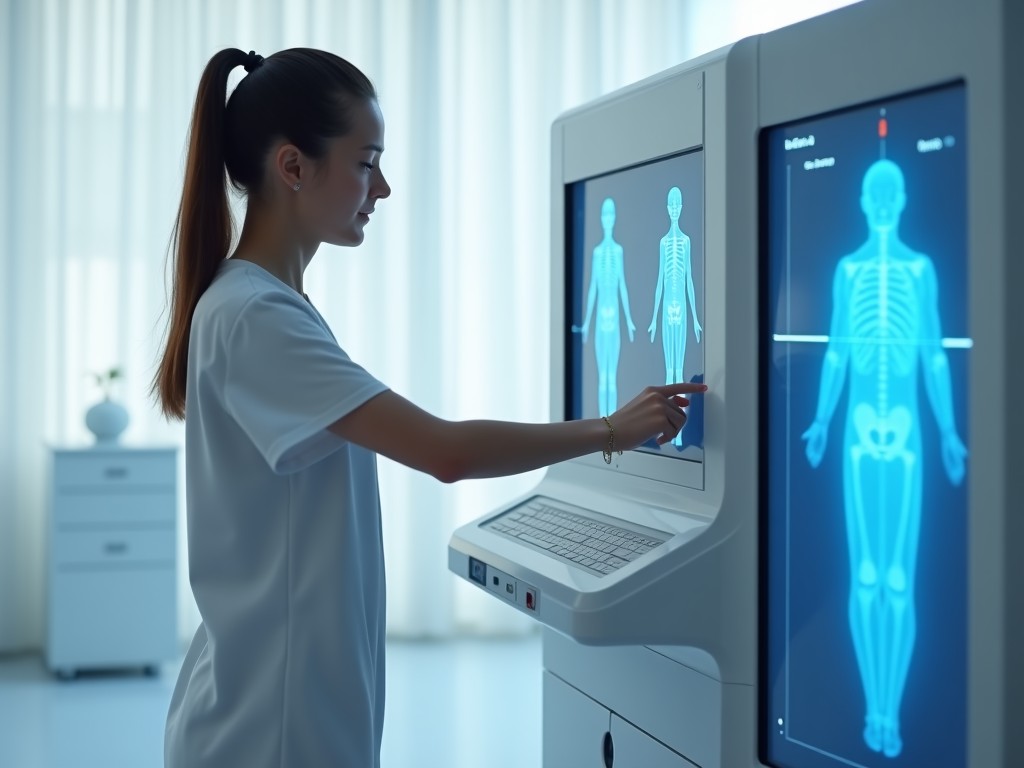
Cost Effective Body Fat Measurement Machine
The device estimates body fat percentage by sending a low‑amplitude alternating current through the torso and measuring the resulting impedance. This bioelectrical impedance analysis (BIA) method
Inquire NowCost-Effective Body Fat Measurement Machine
Overview
The device estimates body fat percentage by sending a low‑amplitude alternating current through the torso and measuring the resulting impedance. This bioelectrical impedance analysis (BIA) method requires no radiation, no consumable reagents, and can be completed in under ten seconds.
Cost effectiveness is achieved through a single‑frequency 50 kHz drive circuit, a reusable electrode array, and a streamlined firmware that eliminates the need for frequent factory calibration. The hardware fits inside a compact IP54‑rated enclosure, making it suitable for repeated use in industrial health‑screening workflows.
Measurement Principle
In BIA, the magnitude of impedance (Z) is inversely related to the amount of conductive lean tissue; fat, being a poor conductor, increases Z. By applying a known current (I) and measuring the voltage drop (V), the device calculates Z = V/I and derives fat mass using empirically validated equations that incorporate height, weight, age, and sex.
A tetra‑polar electrode configuration separates current‑injecting and voltage‑sensing contacts, minimizing the influence of skin‑electrode impedance and improving repeatability across users with varying skin conditions.
Technical Specifications
| Parameter | Typical Value / Customizable |
|---|---|
| Measurement Method | Bioelectrical Impedance Analysis (Single Frequency 50 kHz) |
| Measurement Range | 5 %–50 % body fat |
| Accuracy (vs. DXA) | ±1.5 % BF (typical) |
| Electrode Type | Reusable Ag/AgCl surface electrodes |
| Display | 128×64 LCD with backlight |
| Power Supply | 12 V DC adapter or internal Li‑ion 2000 mAh |
| Operating Temperature | 0 °C–40 °C |
| Dimensions | 180 mm × 90 mm × 45 mm |
| Weight | 350 g |
| Data Output | USB‑CDC (virtual COM) and Bluetooth 4.0 |
| Calibration Interval | 12 months (factory) |
| Enclosure Rating | IP54 |
Design and Construction
The outer case is molded from impact‑resistant ABS with internal ribs that protect the PCB from shock. A silicone gasket around the electrode housing maintains the IP54 rating against dust and splashing water, enabling use in locker rooms or light‑industrial settings.
Internally, a low‑noise analog front‑end amplifies the voltage signal before a 12‑bit ADC samples it at 1 kHz. A 32‑bit microcontroller runs adaptive filtering algorithms to suppress motion artifacts and electrode drift, delivering a stable impedance reading within the measurement window.
Industrial Applications
Workplace wellness programs benefit from rapid, repeatable screenings that identify trends in employee adiposity, allowing targeted interventions without disrupting shift schedules. Because each unit costs significantly less than laboratory‑grade DXA or hydrostatic weighing systems, facilities can deploy multiple devices across sites for comparative analysis.
In occupational health clinics, the machine supports pre‑placement examinations and periodic surveillance for roles where body composition correlates with task performance, such as firefighting or heavy‑equipment operation. Sports training centers use the data to monitor athletes’ off‑season changes and adjust nutrition plans accordingly.
Advantages for Process Integration
A full measurement cycle—including electrode placement, current injection, and result display—requires less than ten seconds, enabling high‑throughput screening. The device stores up to 2000 records locally, which can be exported via USB or Bluetooth to existing health‑management software for longitudinal tracking.
Power draw averages 0.35 W during operation, allowing eight hours of continuous use on the internal battery. The lack of disposable electrodes eliminates recurring consumable costs and reduces bio‑hazard waste, simplifying logistics for large‑scale deployments.
Quality Assurance and Calibration
Before shipment each unit undergoes a factory verification using precision resistors and a tissue‑simulating phantom with known impedance values. The test confirms that the measured resistance falls within ±0.5 % of the reference, traceable to national metrology standards. Users can perform a quick field check with the supplied verification plug to ensure the front‑end remains within tolerance.
Firmware executes a self‑diagnostic at power‑up, checking electrode contact impedance, battery voltage, and sensor integrity. If any parameter exceeds predefined limits, the display shows a service icon and logs the event for maintenance personnel, reducing unexpected downtime.
Customization Options
- Electrode spacing adjusted for specific torso diameters (e.g., pediatric or large‑frame variants)
- Alternative frequencies (10 kHz–100 kHz) available upon request for specialized research protocols
- Enclosure color and laser‑etched branding to match corporate safety‑gear aesthetics
- Optional Wi‑Fi module for wireless LAN integration in facility networks
- Extended‑capacity battery (4000 mAh) for prolonged field campaigns
- Custom firmware output formats (CSV, JSON, HL7) to interface with existing EMR or ERP systems
Frequently Asked Questions
Can the measurement be performed through clothing?
For optimal accuracy the electrodes should contact bare skin; however, thin, non‑conductive fabrics (e.g., a cotton t‑shirt) typically add less than 0.2 kΩ impedance, which the algorithm compensates for within the stated tolerance.
Is any special training required to operate the device?
No. The user places the handheld unit on the sternum, presses the start button, and waits for the automated voice prompt to remove the unit. The process is designed for untrained personnel, minimizing operator variability.
How does the device handle variations in hydration?
Acute hydration changes affect overall impedance; the manufacturer recommends performing measurements under consistent conditions (e.g., same time of day, after voiding, and before food or intense exercise) to obtain reliable trend data.
What is the typical lead time for a standard order?
Standard configurations ship within 3–4 weeks after receipt of purchase order, subject to component availability. Expedited options are available upon request.
Contact for Inquiry
To discuss how this cost‑effective body fat measurement solution can be integrated into your occupational‑health or wellness program, please request a quotation. Our technical team will review your specific requirements, including any desired customizations, and provide a detailed proposal.