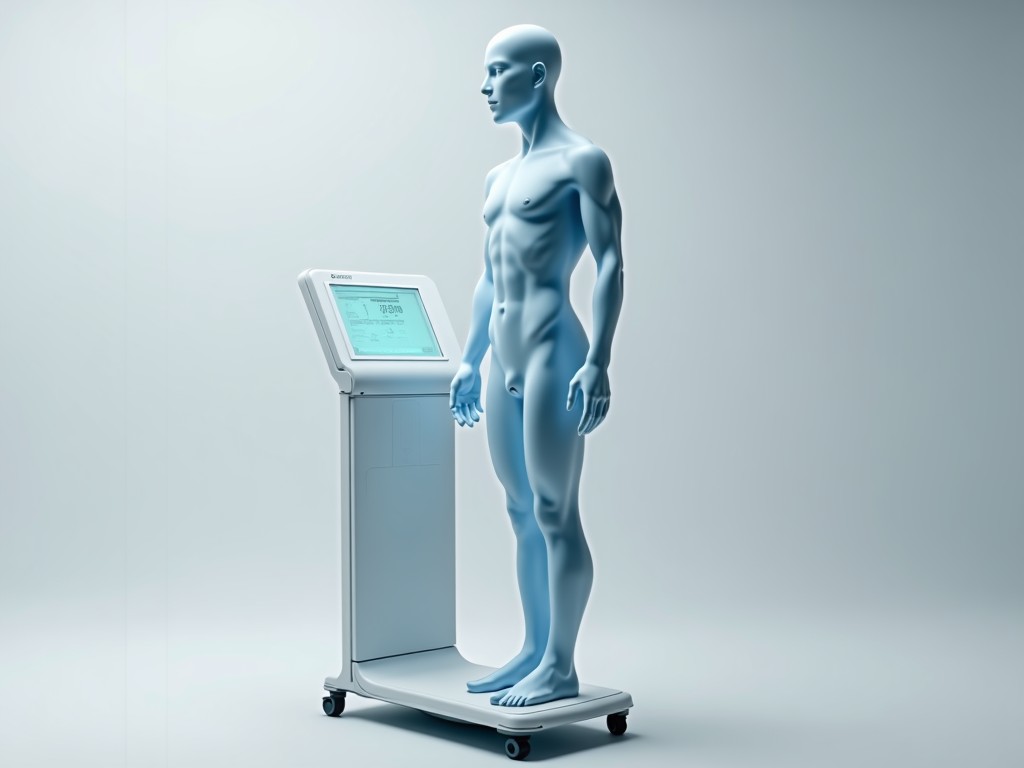
Cost Effective Body Composition Analyzer Scale
Measurement of body composition requires precise impedance sensing across multiple frequencies to differentiate fat, muscle, and water compartments. A cost‑effective analyzer achieves this by using a
Inquire NowCost-Effective Body Composition Analyzer Scale
Measurement of body composition requires precise impedance sensing across multiple frequencies to differentiate fat, muscle, and water compartments.
A cost‑effective analyzer achieves this by using a fixed‑frequency, four‑electrode configuration with calibrated algorithms that deliver repeatability within ±1.5 % for total body water.
Industrial buyers such as wellness equipment manufacturers, corporate health programs, and research labs prioritize low per‑unit cost without sacrificing measurement traceability.
Measurement Technology and Principles
Applied current of 50 µA at 50 kHz passes through the torso via hand‑to‑foot electrodes, generating a voltage proportional to extracellular fluid resistance.
Impedance values are converted to body‑composition estimates using empirically derived equations that account for height, weight, age, and gender.
It uses a fixed 50 kHz excitation; altering the frequency would require recalibration of the proprietary equations and is not offered as a standard option.
Key Technical Specifications
| Parameter | Typical Value | Notes |
|---|---|---|
| Measurement method | Tetra‑polar bioimpedance | Hand‑to‑foot, 4‑electrode |
| Frequency | 50 kHz (single) | Chosen for optimal extracellular fluid sensitivity |
| Current amplitude | 50 µA RMS | Below perception threshold |
| Weight capacity | 180 kg | With safety factor 2× |
| Height input range | 140‑210 cm | Manual entry via keypad |
| Output parameters | Body fat %, muscle mass, total body water, basal metabolic rate | Derived from impedance and anthropometrics |
| Repeatability (SD) | ±0.8 % for fat mass | Based on 10 consecutive measurements |
| Power supply | AA batteries (4) or USB‑C 5 V | Auto‑power‑off after 30 s idle |
Typical Applications and Value Proposition
Wellness equipment manufacturers integrate the analyzer into scales and handheld devices to provide users with actionable health metrics while keeping bill‑of‑materials under $15 per unit.
Corporate health programs deploy the device in on‑site kiosks where employees can obtain a quick body‑composition snapshot; the low maintenance design reduces service contracts.
Research laboratories use the analyzer as a screening tool before more expensive imaging studies, benefiting from its portability and short measurement time (<10 s).
- Low per‑unit cost enables high‑volume OEM integration
- Minimal calibration drift reduces field service frequency
- Simple user interface requires no technical training
Design and Construction Considerations
The housing uses ABS‑PC blend with a wall thickness of 2 mm, providing impact resistance of 0.5 J while keeping weight under 350 g.
Electrodes are stainless‑steel pads with a contact area of 1.2 cm² each, treated with a thin gold‑flash layer to limit oxidation and ensure stable impedance over 10 000 cycles.
Internal PCB employs a 4‑layer layout with separate analog and digital grounds, achieving a signal‑to‑noise ratio greater than 60 dB at the measurement frequency.
Quality Assurance and Calibration
Each unit undergoes a three‑point verification using precision resistors (±0.1 %) to confirm the excitation current and voltage measurement channels.
Stored calibration coefficients are held in EEPROM and can be updated via a service port if field drift exceeds the ±0.5 % threshold.
Traceability to national standards is maintained through a calibrated reference scale with known mass and impedance values, reviewed semi‑annually.
- Visual inspection of electrode integrity
- Functional test: repeatability of three consecutive measurements
- Safety test: leakage current < 10 µA
Customization Options
OEM customers can request alternative electrode layouts (e.g., hand‑to‑hand) to match specific form‑factor constraints.
Firmware can be adjusted to output additional parameters such as visceral fat rating or segmental lean mass, depending on the algorithm license.
Enclosure colors and branding are available through pad‑printing or injection‑molded color changes, with minimum order quantities of 500 units.
Frequently Asked Questions
Can the measurement frequency be changed?
It uses a fixed 50 kHz excitation; altering the frequency would require recalibration of the proprietary equations and is not offered as a standard option.
What information is required before quotation?
Required details include target volume, electrode configuration, any desired output parameters, and enclosure specifications.
How are export shipments protected?
Units are packed in anti‑static foam inserts within double‑wall corrugated cartons, conforming to ISTA‑3A standards.