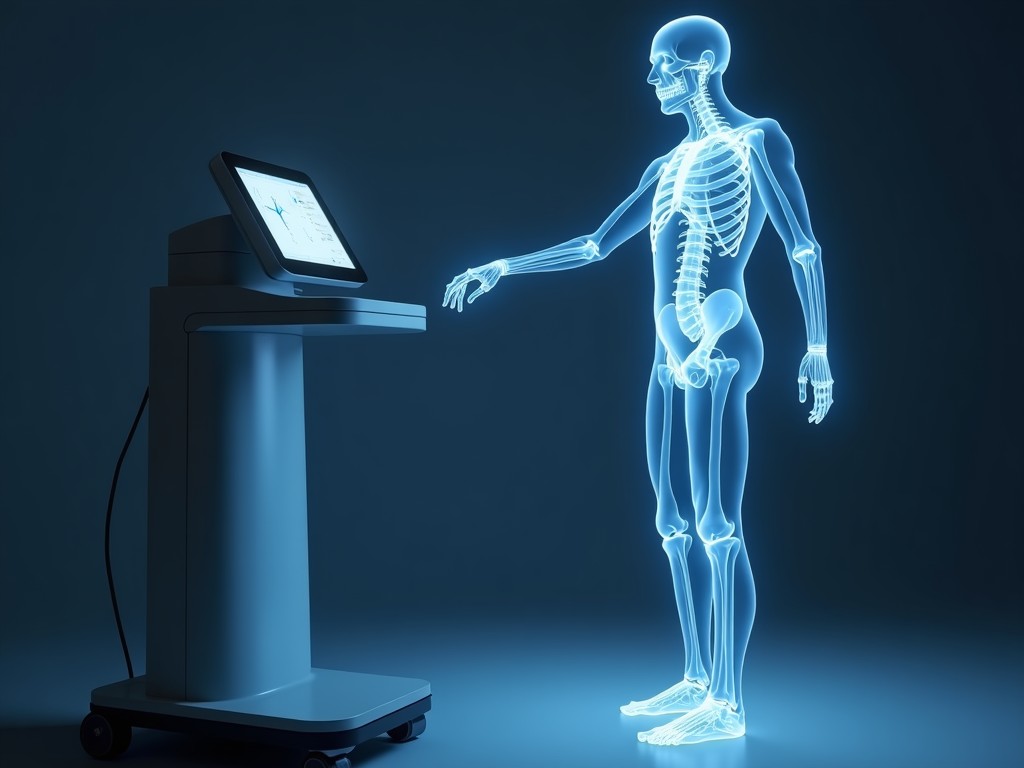
Cost Effective Bia Body Composition Analyzer
Bioelectrical impedance analysis (BIA) estimates body composition by passing a low‑level alternating current through the torso and limbs and measuring the resulting voltage drop. The impedance
Inquire NowCost-Effective BIA Body Composition Analyzer
Bioelectrical impedance analysis (BIA) estimates body composition by passing a low‑level alternating current through the torso and limbs and measuring the resulting voltage drop. The impedance magnitude and phase angle at specific frequencies correlate with total body water, extracellular water, and fat‑free mass, enabling calculation of body fat percentage, muscle mass, and basal metabolic rate.
Measurement Principle and Technical Approach
The analyzer uses a tetrapolar electrode configuration with four surface contacts: two current‑injecting electrodes and two voltage‑sensing electrodes. This arrangement minimizes electrode polarization effects and improves measurement stability across a frequency sweep from 5 kHz to 50 kHz.
Impedance is sampled at multiple frequencies to generate a Cole‑Cole plot, from which intracellular and extracellular resistance are extracted using a Cole‑Cole model fitting algorithm. The resulting parameters are applied to empirically derived equations validated against dual‑energy X‑ray absorptiometry (DXA) reference data.
Key Performance Characteristics
| Parameter | Typical Value / Range |
|---|---|
| Measurement Frequencies | 5 kHz, 50 kHz (dual‑frequency) or 5‑50 kHz sweep (multi‑frequency) |
| Current Excitation | ≤ 0.8 mA RMS, sinusoidal |
| Voltage Measurement Resolution | 0.1 mV |
| Impedance Range | 150 Ω – 1200 Ω |
| Body Fat % Accuracy | ±1.5 % (vs. DXA) typical |
| Repeatability (CV) | < 2 % typical |
| Measurement Time | < 10 s per test |
| Power Consumption | ≤ 2 W (idle < 0.2 W) |
| Display | 128 × 64 pixel LCD with backlight |
| Data Interface | USB‑CDC, optional RS‑232 or Bluetooth LE |
Design for Cost Effectiveness
The instrument reduces bill‑of‑materials cost by employing a mixed‑signal microcontroller with integrated DAC and ADC, eliminating the need for separate analog front‑end ICs. The electrode cables use inexpensive snap‑on connectors that are replaceable in the field, lowering service expenses.
Mechanical housing is fabricated from ABS‑polycarbonate blend with snap‑fit assembly, avoiding screws and reducing production time. Internal PCB is a two‑layer FR‑4 design with standardized component footprints, facilitating automated pick‑and‑place manufacturing.
Firmware implements impedance measurement using a discrete Fourier transform (DFT) with fixed‑point arithmetic, which reduces CPU load and allows operation at 48 MHz clock speed, further decreasing component cost.
Industrial and Commercial Applications
Fitness centers utilize the analyzer for member onboarding and progress tracking because the short test time and non‑invasive nature improve throughput compared to skinfold calipers.
Clinical wellness programs integrate the device into routine health screenings to monitor changes in visceral fat and sarcopenia risk, supporting early intervention strategies.
Corporate wellness departments deploy portable units at office health fairs; the lightweight (< 1.2 kg) design and battery operation enable rapid deployment without dedicated power outlets.
Research laboratories use the multi‑frequency mode to collect raw impedance data for custom hydration models, benefitting from the open data output via USB.
Customization Options
- Electrode layout: hand‑to‑hand, foot‑to‑foot, or segmental (arm‑leg) configurations
- Housing color and labeling: OEM branding, silk‑screen or laser etching
- Software: custom report templates, data export formats (CSV, JSON), API for EMR integration
- Power options: internal rechargeable Li‑ion pack, external AC adapter, or PoE‑compatible version
Quality Assurance and Testing
Each unit undergoes a four‑point impedance verification using precision resistors traceable to national standards, ensuring measurement accuracy within the specified tolerance.
Environmental stress testing includes temperature cycling (‑10 °C to +50 °C) and humidity exposure (up to 90 % RH non‑condensing) to validate long‑term drift performance.
Final inspection incorporates a functional test suite: electrode continuity check, battery charge cycle, and wireless pairing verification where applicable.
Frequently Asked Questions
Can the electrode spacing be adjusted for different patient sizes?
The standard snap‑on electrodes have a fixed spacing optimized for adult torso measurements; pediatric adapters with reduced spacing are available upon request.
What information is required before a quotation?
To provide an accurate quote we need the intended measurement mode (single, dual, or multi‑frequency), electrode configuration, housing customization details, and expected annual volume.
Which materials are available for the housing?
Standard housing is ABS‑PC blend; alternative polycarbonate or recycled‑content polymers can be supplied depending on project requirements.
How is quality inspected for bulk orders?
Each lot receives statistical process control monitoring of key parameters (impedance offset, gain, and battery voltage) and a random sample undergoes full functional verification.
What packaging methods protect the units during export?
Units are packed in corrugated cartons with interior foam inserts; each carton includes a moisture barrier and is labeled with handling instructions.
Request Information
For technical data sheets, customization inquiries, or to arrange a sample evaluation, contact our engineering team.