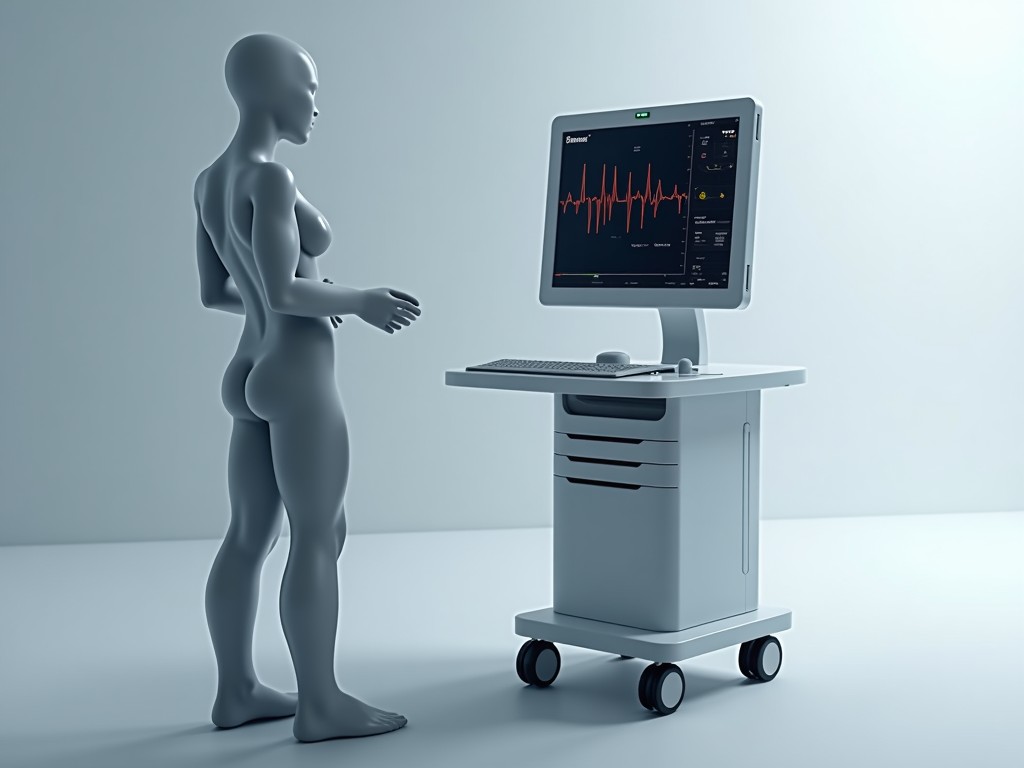
China Bioelectrical Impedance Analysis Machine
Bioelectrical impedance analysis sends a safe, low‑amplitude alternating current through the body and measures the resulting voltage drop. The impedance value depends on the amount and type of tissue
Inquire NowChina Bioelectrical Impedance Analysis Machine
Overview
Bioelectrical impedance analysis sends a safe, low‑amplitude alternating current through the body and measures the resulting voltage drop. The impedance value depends on the amount and type of tissue the current encounters, allowing estimation of body composition.
Multi‑frequency capability improves separation of intracellular and extracellular water, which is essential for accurate fat‑free mass and total body water calculations.
Technical Specifications
| Parameter | Typical Value |
|---|---|
| Measurement frequency range | 5 kHz – 250 kHz (selectable steps) |
| Number of electrodes | 8‑point tactile electrodes (hand‑to‑foot) |
| Output metrics | Body fat %, fat‑free mass, total body water, intracellular water, extracellular water, basal metabolic rate |
| Current amplitude | ≤ 0.8 mA rms (IEC 60601‑2‑27 compliant) |
| Power supply | AC 100‑240 V, 50/60 Hz, 30 VA max |
| Display | 5‑inch LCD, 800×480 pixels, touch‑screen |
| Operating temperature | 10 °C – 40 °C |
| Dimensions (W×D×H) | 320 mm × 260 mm × 110 mm |
| Weight | 4.2 kg |
Working Principle
When a sinusoidal current passes through the body, tissues with high water and electrolyte content (such as muscle) present low impedance, while fat tissue exhibits higher impedance due to its low conductivity.
By measuring impedance at multiple frequencies, the device can model the body as a combination of conductive and capacitive components, enabling separation of intracellular and extracellular fluid volumes.
The measured values are fed into validated empirical equations (e.g., Lukaski, Kyle) that correlate impedance, height, weight, age, and sex with body composition percentages.
Electrode placement follows standard hand‑to‑foot protocol to ensure consistent current paths across users.
Built‑in temperature compensation adjusts for skin‑surface variations that could affect resistance readings.
Applications
The instrument is suited for environments where repeated, non‑invasive body‑composition tracking is required, providing data that supports training adjustments, nutritional planning, and health‑risk assessment.
- Fitness centers – monitoring muscle gain and fat loss over training cycles.
- Clinical nutrition – assessing fluid status in dialysis or cardiac patients.
- Research laboratories – longitudinal studies on aging, obesity, or sarcopenia.
- Occupational health – evaluating workforce fitness for physically demanding roles.
- Wellness programs – providing members with actionable body‑composition feedback.
Quality Control & Manufacturing
Each unit undergoes a four‑point calibration traceable to national standards, verifying current amplitude, voltage measurement, and frequency accuracy before leaving the factory.
Housing is constructed from ABS‑PC blend with UL‑94 V‑0 rating, providing impact resistance and protection against ingress of dust and moisture (IP21).
Electrodes are medical‑grade stainless steel with a biocompatible coating, tested for skin irritation per ISO 10993‑10.
Final inspection includes functional test of all measurement ranges, visual inspection of display pixels, and verification of safety interlocks.
Customization Options
Manufacturers can adapt the device to specific workflow or regional requirements without altering the core measurement electronics.
- Electrode type – disposable snap‑on or reusable gel‑based variants.
- Software interface – language packs, custom report templates, data export formats (CSV, HL7).
- Branding – logo placement on housing and startup screen.
- Packaging – single‑unit cartons or bulk pallet packs with shock‑absorbent inserts.
- Accessories – carrying case, adjustable foot platform, height‑measurement stadiometer.
Frequently Asked Questions
Can the measurement frequency be adjusted for specific protocols?
Yes, the device offers selectable frequencies at 5 kHz, 50 kHz, and 250 kHz, which can be combined or used independently based on the desired fluid compartment analysis.
What information is needed to generate a quotation?
Required details include order quantity, preferred electrode type, any software customizations, destination country for shipping estimates, and desired delivery timeline.
How is measurement repeatability verified?
Repeatability is assessed by performing ten consecutive measurements on a reference phantom; the coefficient of variation typically remains below 1.5 % for impedance readings.
What warranty and after‑sales support are offered?
Standard warranty covers 24 months for parts and labor; optional extended service plans include on‑site calibration and priority spare‑parts shipping.
Contact Us
To discuss specifications, request a quotation, or arrange a product demonstration, please reach out to our technical sales team.