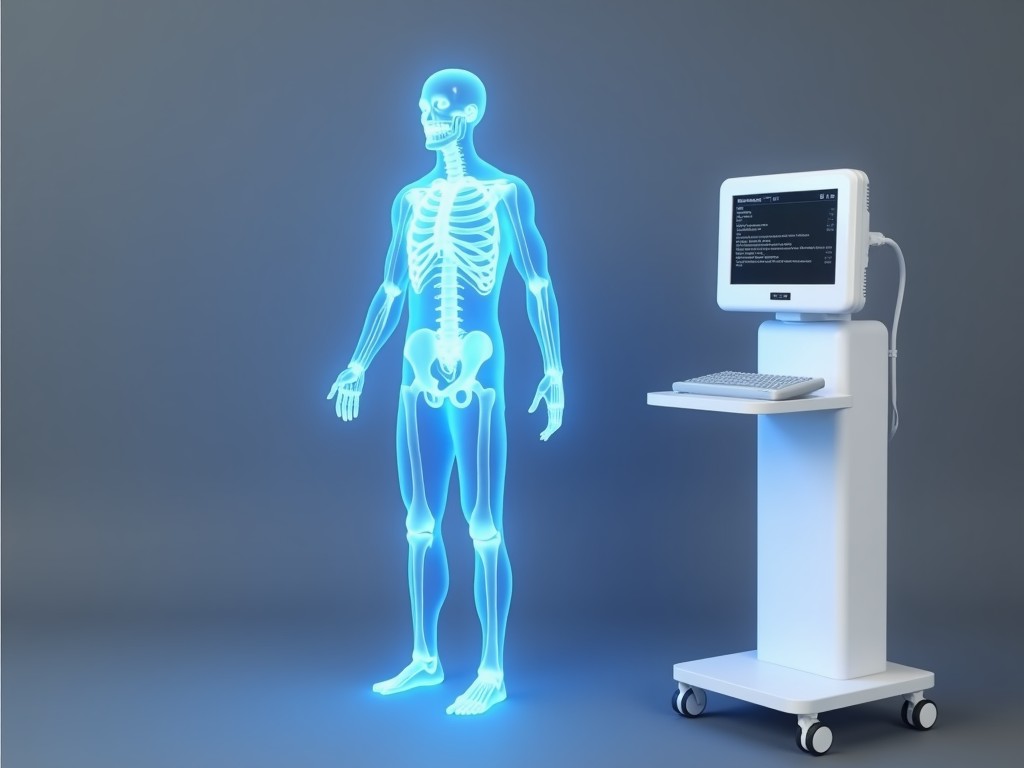
Buy Digital Body Composition Analyzer
The device determines body composition by sending a low‑level alternating current through tactile electrodes and measuring the resulting impedance. Multi‑frequency bioelectrical impedance analysis
Inquire NowDigital Body Composition Analyzer
The device determines body composition by sending a low‑level alternating current through tactile electrodes and measuring the resulting impedance. Multi‑frequency bioelectrical impedance analysis (BIA) separates intracellular and extracellular water pathways, enabling calculation of fat mass, fat‑free mass, segmental lean mass, visceral fat level, total body water, basal metabolic rate and phase angle.
Compared with analog impedance meters, the digital platform provides repeatable voltage‑current sampling, on‑board signal processing and data logging. This reduces operator‑dependent variability and allows storage of trend data for longitudinal monitoring.
Measurement is initiated by placing hands and feet on eight stainless‑steel contact pads. A safe alternating current (typically <500 µA) is applied at frequencies ranging from 5 kHz to 500 kHz. The impedance spectrum is captured, and proprietary equations derived from population‑specific validation studies convert resistance and reactance values into body‑composition metrics.
Electrode geometry influences current paths; the eight‑point tactile arrangement enables segmental analysis of the arms, legs and trunk. This configuration provides localized lean‑mass data useful for rehabilitation monitoring and athletic training adjustments.
Typical frequency sets include 5, 50, 100, 250 and 500 kHz. Low frequencies predominantly reflect extracellular water, while higher frequencies penetrate cell membranes, allowing intracellular water estimation. The multi‑frequency approach improves accuracy for subjects with abnormal hydration states.
Output parameters are displayed on a 7‑inch capacitive touchscreen (800×480 px) and can be exported via USB, Ethernet or optional Wi‑Fi. The interface supports HL7 messaging for integration with electronic medical records and custom APIs for third‑party fitness platforms.
Under standardized testing conditions (fasted state, voided bladder, ambient temperature 22±2 °C), the coefficient of variation for fat‑mass measurement is ≤1.5 %. A full measurement cycle completes in less than 20 seconds, supporting high‑throughput screening in clinics or wellness centers.
The unit operates from a universal 100‑240 V AC, 50/60 Hz supply with a maximum power draw of 30 W. An optional internal lithium‑ion battery provides up to four hours of mobile operation for field studies or outreach programs.
Technical Specifications
| Parameter | Typical Value / Range | Notes |
|---|---|---|
| Measurement Method | Multi‑frequency Bioelectrical Impedance Analysis (8‑point tactile electrodes) | Segmental and whole‑body modes |
| Frequency Range | 5 kHz – 500 kHz (typically 5, 50, 100, 250, 500 kHz) | Enables intra‑ and extracellular water separation |
| Measured Parameters | Fat mass, Fat‑free mass, Segmental lean mass (arms, legs, trunk), Visceral fat level, Total body water, Intracellular/Extracellular water, Basal metabolic rate, Phase angle | Derived from impedance spectrum using validated equations |
| Measurement Time | <20 seconds | Subject to proper electrode contact |
| Repeatability (CV) | ≤1.5 % for fat mass | Under standardized fasting, voided bladder, 22±2 °C |
| Operating Temperature | 10 °C – 40 °C | Ambient conditions |
| Storage Temperature | ‑20 °C – 60 °C | Non‑operating |
| Power Supply | 100‑240 V AC, 50/60 Hz, ≤30 W | Universal input |
| Data Output | USB 2.0, Ethernet (TCP/IP), optional Wi‑Fi, HL7‑compatible | Configurable per order |
| Display | 7‑inch capacitive touchscreen, 800×480 px | Glove‑compatible option available |
| Dimensions (W×D×H) | 350 mm × 300 mm × 110 mm | Desktop footprint |
| Weight | ≈4.5 kg | Includes accessories |
| Calibration | Factory calibrated; verification kit available | Traceable to national standards |
| Compliance | IEC 60601‑2‑26, ISO 13485, CE marked | Medical device classification |
Typical Industrial Applications
In fitness and wellness centers, the analyzer supports member onboarding by establishing baseline fat‑free mass and tracking changes over training cycles. Segmental lean‑mass data helps trainers identify muscular imbalances and tailor resistance programs.
Corporate health programs use the device for periodic employee screenings. Visceral fat level and basal metabolic rate provide early indicators of metabolic risk, enabling targeted lifestyle interventions before clinical thresholds are reached.
Medical clinics and bariatric surgery units rely on pre‑operative and post‑operative measurements to assess fluid shifts, muscle preservation and fat loss. The multi‑frequency approach distinguishes edema‑related weight changes from true tissue mass variation, which is critical for dosing medications and planning rehabilitation.
Research laboratories employ the analyzer for longitudinal studies on aging, sarcopenia and nutrition interventions. The ability to export raw impedance spectra allows investigators to apply custom modeling equations or validate new population‑specific algorithms.
Occupational health services in industries with shift work or extreme environments use the device to monitor hydration status and intracellular water fluctuations. Early detection of dehydration or over‑hydration helps prevent heat‑related illness and optimize work‑rest schedules.
Customization Options
- Electrode configuration – hand‑only, foot‑only, hand‑to‑foot, or full segmental arrays
- Software packages – basic analytics, advanced trend reporting, API integration for third‑party platforms
- Enclosure materials – standard ABS, antimicrobial‑coated polymer, or stainless‑steel housing for harsh environments
- Mounting options – desktop stand, wall‑mount bracket, or integration with floor‑scale platforms
- Language/UI localization – available in over 20 languages with adjustable font sizes
- Service plans – extended warranty, on‑site calibration, and preventive maintenance contracts
Quality Assurance & Testing
Each unit undergoes design verification that includes electrical safety testing per IEC 60601‑1, electromagnetic compatibility (IEC 60601‑1‑2) and biocompatibility of electrode surfaces (ISO 10993‑5). These assessments confirm that the applied currents remain below sensory thresholds and do not induce tissue irritation under normal use.
Environmental testing subjects the analyzer to temperature cycling (‑20 °C to 60 °C), humidity exposure (up to 95 % RH non‑condensing) and vibration profiles simulating transport and handheld operation. Results ensure that measurement drift remains within specification limits across the expected lifespan.
Firmware is validated through unit‑level code reviews, hardware‑in‑the‑loop testing and regression suites that verify calculation algorithms against reference data obtained from dual‑energy X‑ray absorptiometry (DXA) and magnetic resonance imaging (MRI) studies. Version control and change‑management practices maintain traceability from source code to released builds.
Production lots are tracked with unique serial numbers, and each device receives a factory calibration certificate traceable to national metrology institutes. A verification kit containing known‑impedance resistors allows users to confirm measurement integrity on a monthly basis without returning the unit to the manufacturer.
Frequently Asked Questions
- Can the analyzer be used on patients with implanted electronic devices? – The alternating current is generally considered contraindicated for individuals with pacemakers or implanted defibrillators due to potential interference; a medical consultation is required prior to measurement.
- What preparation is necessary for repeatable results? – Subjects should fast for at least 4 hours, avoid vigorous exercise for 12 hours, empty the bladder, and maintain consistent hydration status. Measurements are best performed at the same time of day to minimize diurnal fluid shifts.
- Is integration with existing health‑management software possible? – Yes, the unit supports HL7 messaging over Ethernet and offers a RESTful API for custom data exchange with electronic medical records, wellness platforms or research databases.
- Are the electrodes replaceable, and what is their expected lifespan? – The stainless‑steel contact pads are user‑replaceable. Under typical clinical use (≥10 measurements per day) they retain performance for approximately 10 000 cycles before replacement is advised.
- What is the recommended calibration interval? – Factory calibration is valid for 12 months under normal operating conditions. Monthly verification using the supplied kit is recommended; any deviation beyond 0.5 % triggers recalibration.
- Can the device operate on battery power for mobile outreach? – An optional internal lithium‑ion battery provides up to four hours of continuous operation, suitable for community health events or field studies where mains power is unavailable.
- What warranty coverage is provided? – A standard 24‑month limited warranty covers parts and labor. Optional extensions to 36 or 60 months are available, as well as on‑site service contracts.