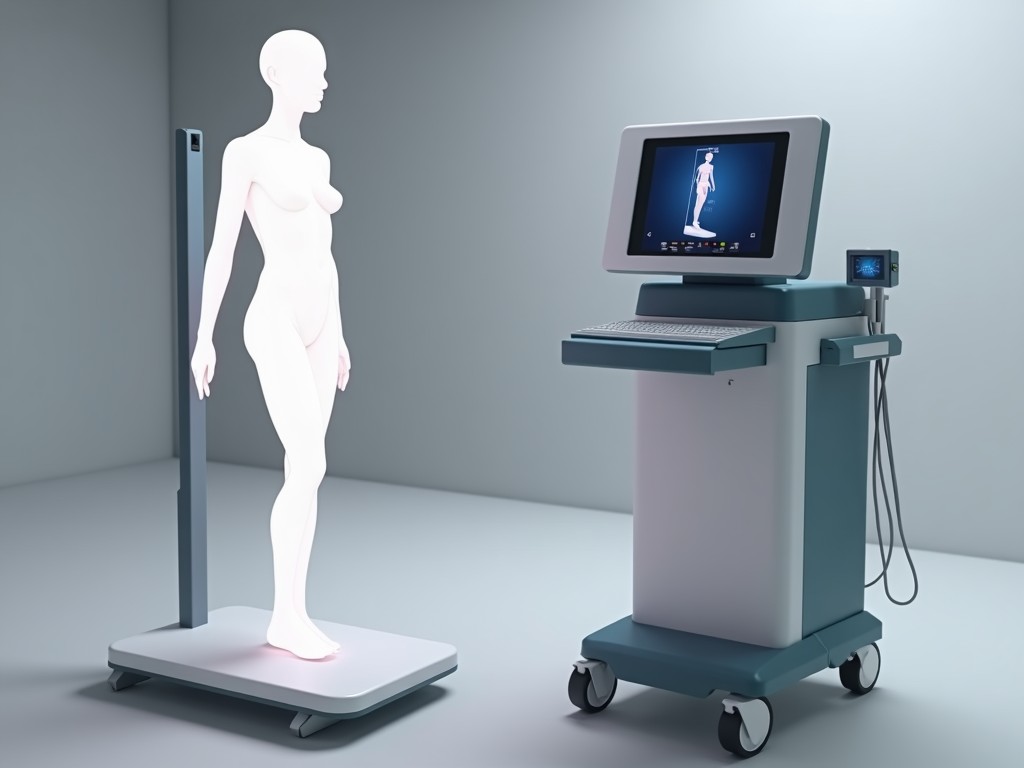
Buy Body Composition Analyzer Machine
A body composition analyzer quantifies the proportion of fat, muscle, bone, and water in human tissue using bioelectrical impedance. The device sends a low‑level alternating current through
Inquire NowBuy Body Composition Analyzer Machine
A body composition analyzer quantifies the proportion of fat, muscle, bone, and water in human tissue using bioelectrical impedance. The device sends a low‑level alternating current through electrodes placed on the hands and feet, measuring the resulting voltage drop to calculate impedance values at multiple frequencies.
Measurement Technology
Multi‑frequency BIA typically uses frequencies ranging from 1 kHz to 1 MHz to differentiate intracellular and extracellular water. Segmental analysis employs separate electrode pairs for each limb and the torso, providing regional impedance data that improves accuracy for individuals with atypical body proportions.
Measurement repeatability is generally expressed as a coefficient of variation below 0.5 % for body fat percentage when the same subject is tested under consistent hydration and posture conditions. The instrument’s internal reference circuit maintains current stability within ±0.1 % over the measurement cycle.
Key Technical Specifications
| Parameter | Typical Value | Notes / Options |
|---|---|---|
| Operating Frequencies | 1 kHz – 1 MHz (5‑point) | Adjustable via firmware |
| Electrode Type | Ag/AgCl snap‑on or reusable stainless steel | Contact resistance <10 kΩ |
| Measurement Range | Body Fat: 2 % – 60 % | Muscle Mass: 15 % – 80 % |
| Repeatability (CV) | ≤0.5 % (body fat) | Under standardized conditions |
| Power Consumption | <5 W (idle) | USB‑C or mains adapter |
| Display | 5‑inch LCD, 800×480 px | Touch‑screen optional |
Design and Construction
The enclosure is fabricated from ABS‑PC blend with a UL‑94 V‑0 flame rating, providing impact resistance up to 5 J and protection against dust and moisture to IP20. Internal circuitry uses a four‑layer PCB with ground planes to reduce electromagnetic interference, ensuring signal‑to‑noise ratio greater than 60 dB at 100 kHz.
Electrode cables are shielded twisted‑pair with a nominal impedance of 100 Ω, terminated in gold‑plated connectors to minimize contact drift. The user interface includes a capacitive touch panel with a response time under 30 ms and a physical standby button rated for 100 000 actuations.
Application Areas
- Fitness centers use segmental data to tailor training programs, as limb‑specific muscle mass correlates with strength outcomes.
- Clinical settings rely on extracellular water measurements to monitor edema progression in cardiac or renal patients.
- Research laboratories require multi‑frequency impedance spectra for studying hydration dynamics during exercise protocols.
- Corporate wellness programs benefit from rapid, non‑invasive screening that can be completed in under 30 seconds per subject.
Selection and Customization
Base models provide whole‑body impedance at five fixed frequencies. Optional modules enable additional frequencies (up to 10 points) for enhanced tissue‑type resolution, or wireless Bluetooth Low Energy transmission for integration with mobile health platforms.
Electrode configurations can be changed from hand‑to‑foot to hand‑to‑hand or foot‑to‑foot arrangements, accommodating populations with limited mobility. Software licensing tiers offer raw data export, longitudinal tracking APIs, and compliance reporting formats such as HL7 or CSV.
Quality Assurance
Each unit undergoes a factory calibration traceable to a national metrology institute using precision resistors and phantom tanks with known conductivity. Verification includes impedance linearity tests from 100 Ω to 10 kΩ and phase angle accuracy within ±0.5°. Final inspection checks electrode contact resistance, display uniformity, and firmware checksum before packaging.
Manufacturing follows documented work instructions with statistical process control on critical dimensions such as electrode spacing ( tolerance ±0.2 mm) and PCB trace width ( ±10 %). Non‑conforming parts are quarantined and analyzed to prevent recurrence.
Common Inquiries
- Can the measurement frequency set be altered after purchase?
- Yes, the firmware supports user‑defined frequency tables that can be uploaded via the USB‑C port.
- What information is required for a quotation?
- Quantity, desired electrode type, any optional modules (wireless, extra frequencies), and preferred delivery destination.
- How is the device sanitized between users?
- Electrode surfaces can be wiped with 70 % isopropyl alcohol; the enclosure is resistant to common disinfectants.
Next Steps
To receive a detailed quotation or discuss configuration options, please provide your application requirements and contact information.
Request Quote