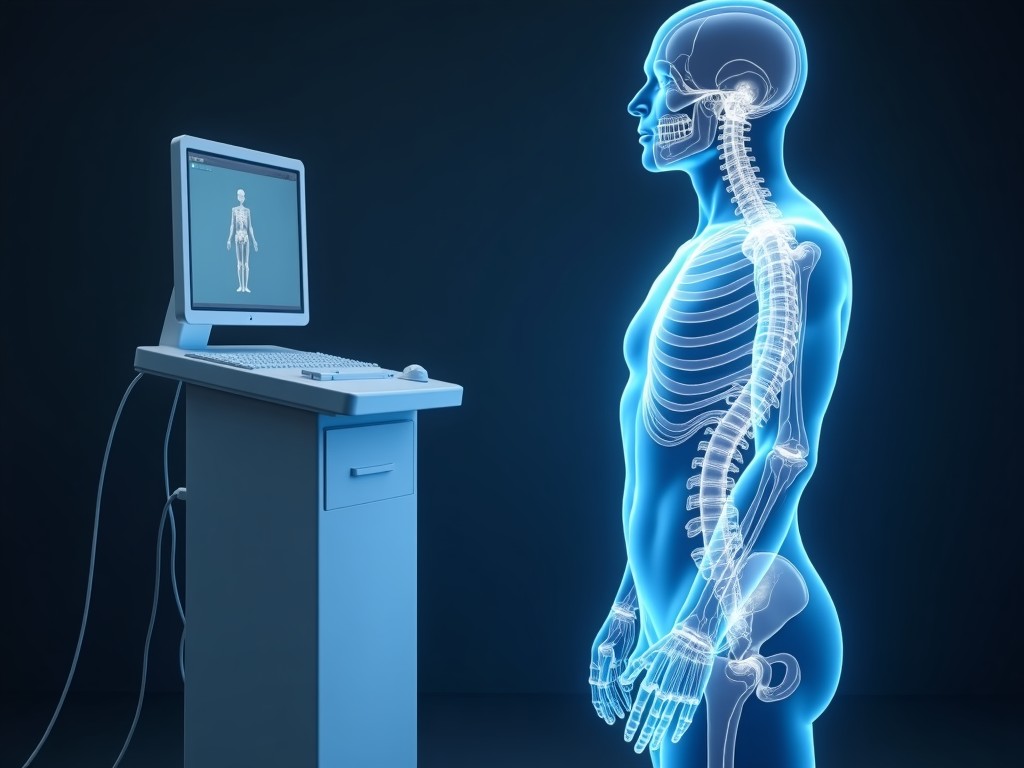
Buy Advanced Body Composition Analyzer Machine
The device estimates body composition by sending low‑level alternating currents through the torso and limbs and measuring the resulting impedance at multiple frequencies. Different frequencies
Inquire NowAdvanced Body Composition Analyzer Machine
The device estimates body composition by sending low‑level alternating currents through the torso and limbs and measuring the resulting impedance at multiple frequencies.
Different frequencies penetrate tissue to varying depths. Low frequencies (5 kHz) mainly reflect extracellular fluid, while higher frequencies (500 kHz) penetrate cell membranes, enabling estimation of intracellular compartments.
Measurement Principle and Technical Basis
The analyzer uses eight tactile electrodes placed on the hands and feet. A constant‑current source drives a sinusoidal signal from 5 kHz to 500 kHz, and a voltmeter records the voltage drop across each segment. Impedance values are fed to a proprietary algorithm that derives segmental volumes for arms, legs, and trunk.
Key Performance Characteristics
Repeatability is expressed as coefficient of variation (CV) across consecutive measurements on the same subject. Typical CV values are below 1.5 % for fat‑free mass and below 2.0 % for fat mass when the device is warmed up and electrodes are properly cleaned.
Measurement duration depends on the selected protocol. A full segmental scan completes in approximately 20 seconds, while a quick whole‑body estimate can be obtained in under 5 seconds.
Operating temperature range is specified from 10 °C to 35 °C with relative humidity up to 80 % non‑condensing. The device stores up to 500 user profiles internally and can export data via USB or Ethernet.
Typical Applications
- Fitness centers: need rapid, non‑invasive assessment to track client progress and adjust training programs.
- Medical clinics: require precise fluid balance monitoring for dialysis, nutrition, and rehabilitation patients.
- Research laboratories: demand segmental data for studies on sarcopenia, obesity, and metabolic syndrome.
- Corporate wellness programs: benefit from automated reporting that integrates with employee health platforms.
Technical Specifications
| Parameter | Value / Range |
|---|---|
| Measurement Method | Bioelectrical Impedance Analysis (multi‑frequency, segmental) |
| Frequency Range | 5 kHz – 500 kHz (8 frequencies) |
| Number of Electrodes | 8 tactile (hands & feet) |
| Segmental Analysis | Arms, legs, trunk (5 segments) |
| Measurement Time | 20 s (full segmental), <5 s (quick whole‑body) |
| Repeatability (CV) | ≤1.5 % FFM, ≤2.0 % FM (typical) |
| Accuracy vs DXA | R² >0.94 for fat mass, R² >0.96 for fat‑free mass |
| Power Supply | 100‑240 V AC, 50/60 Hz, 30 VA |
| Dimensions (W×D×H) | 350 mm × 300 mm × 110 mm |
| Weight | 4.2 kg |
| Operating Temperature | 10 °C – 35 °C |
| Storage Temperature | −20 °C – 60 °C |
| Interface | USB 2.0, Ethernet (RJ45), optional Wi‑Fi |
| Display | 7‑inch touchscreen, 800×480 pixels |
| Ingress Protection | IP21 (protected against vertical dripping water) |
Quality Assurance and Calibration
Each unit undergoes factory calibration against a reference dual‑energy X‑ray absorptiometry (DXA) scanner. Calibration coefficients are stored in non‑volatile memory and verified every 12 months or after 10 000 measurements, whichever occurs first.
The housing is constructed from ABS‑polycarbonate blend with a surface resistivity <10⁹ Ω to minimize static interference.
Customization Options
Optional software modules allow integration with electronic medical record (EMR) systems via HL7 or FHIR interfaces.
Language packs can be added for Spanish, French, Mandarin, and Arabic without hardware changes.
Electrode cable length can be extended from the standard 1.2 m to up to 3.0 m for wheelchair‑accessible installations.
Frequently Asked Questions
A: Yes, the analyzer supports user‑defined frequency sets and segmental grouping; contact technical support for validation requirements.
A: Provide intended application, estimated annual volume, any required certifications (e.g., CE, FDA), and preferred language or interface options.
A: Units are packed in double‑wall corrugated cartons with interior foam inserts, sealed with humidity‑indicating cards, and palletized for container loading.
A: Standard lead time is 6‑8 weeks for stock configurations; customized units may require an additional 2‑3 weeks for firmware and cable modifications.
Contact for Inquiry
To receive a detailed quotation, technical datasheet, or arrange a product demonstration, please complete the inquiry form.
The engineering team will respond within one business day with configuration options, pricing, and lead‑time information.
Request Information