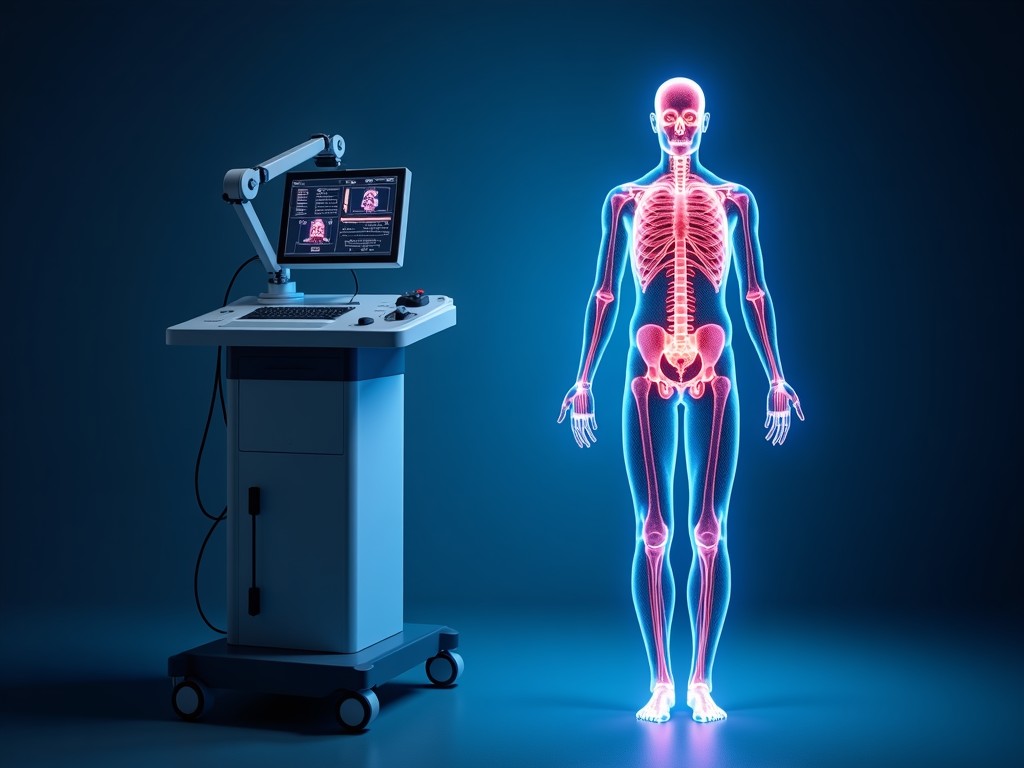
Bioelectrical Impedance Analysis Machine Supplier
Bioelectrical impedance analysis (BIA) estimates body composition by sending a low‑amplitude alternating current through the body and measuring the resulting voltage drop. The impedance value depends
Inquire NowBioelectrical Impedance Analysis Machine Supplier
Bioelectrical impedance analysis (BIA) estimates body composition by sending a low‑amplitude alternating current through the body and measuring the resulting voltage drop. The impedance value depends on the volume and conductivity of intracellular and extracellular fluids, allowing calculation of fat‑free mass, total body water, and phase angle.
Measurement Principle
A tetra‑polar configuration minimizes electrode polarization effects. Typically, a 50 kHz sinusoidal current of < 1 mA is injected via surface electrodes placed on the hand and foot. The device records the resistance (R) and reactance (Xc) components, from which impedance (Z) and phase angle (φ) are derived. Multi‑frequency models extend the range from 1 kHz to 1 MHz to improve intra‑ and extracellular fluid separation.
Typical Technical Specifications
| Parameter | Typical Value | Unit | Notes |
|---|---|---|---|
| Measurement Frequencies | 1, 5, 50, 100, 200, 500 kHz | kHz | Multi‑frequency optional |
| Current Amplitude | ≤ 1 | mA rms | Within IEC safety limits |
| Impedance Range | 150 – 1200 | Ω | Dependent on electrode placement |
| Phase Angle Range | 3 – 12 | ° | Reflects cellular integrity |
| Display Resolution | 0.1 | Ω / 0.1° | Digital readout |
| Power Supply | 100‑240 | V AC, 50/60 Hz | Universal input |
| Operating Temperature | 10 – 40 | °C | Non‑condensing |
Industrial Applications
BIA equipment serves sectors where rapid, non‑invasive body‑composition data support decision making. In occupational health programs, periodic tracking of fluid balance helps identify early signs of dehydration or overhydration in shift workers. Fitness facilities use segmental analysis to tailor training regimens based on limb‑specific muscle mass. Clinical research labs rely on multi‑frequency BIA to study edema progression in cardiac or renal patients, while nutritional monitoring in long‑term care benefits from reproducible total‑body water estimates.
- Occupational wellness programs
- Fitness and performance centers
- Hydration monitoring in sports medicine
- Clinical trials for fluid‑status biomarkers
- Nutritional assessment in geriatric care
Customization Options
Suppliers adapt hardware and software to match specific workflow requirements. Electrode cables can be supplied with different connector types (e.g., snap, pinch, or adhesive) to suit reusable or disposable interfaces. Enclosure materials range from ABS plastic for portable units to stainless‑steel‑grade housings for high‑traffic clinical environments. Firmware can be configured to export data via USB, Bluetooth, or HL7‑compatible interfaces, allowing integration with electronic health records or gym management systems.
- Electrode type: reusable metal, disposable gel‑covered, or textile‑based
- Cable length: 0.5 m to 2 m, shielded or unshielded
- Housing rating: IP20 (office) or IP65 (wash‑down)
- Output formats: CSV, JSON, DICOM, HL7
- Language packs: English, Spanish, Mandarin, etc.
Quality Assurance
Manufacturing follows ISO 13485‑aligned processes for medical‑device‑class equipment. Each unit undergoes a four‑step test: (1) electrical safety verification per IEC 60601‑1, (2) impedance accuracy check against a precision resistor network, (3) repeatability assessment with ten consecutive measurements on a phantom torso, and (4) software validation for data export integrity. Calibration certificates are traceable to national metrology institutes and are provided with every shipment.
Frequently Asked Questions
Can the electrode placement be adapted for segmental analysis?
Yes. Additional electrode sets allow measurement of trunk, arm, and leg segments separately, enabling regional fluid distribution analysis.
What information is needed before a quotation?
Specify the desired frequency range, number of segments, electrode type, housing rating, and any required data‑output interface. Volume estimates help determine pricing tiers.
How are devices protected during export shipping?
Units are packed in double‑wall corrugated cartons with foam inserts, sealed with humidity‑indicating cards, and strapped to pallets. Shock‑watch labels monitor handling impacts.
Contact for Inquiry
To discuss specifications, request a sample unit, or obtain a detailed lead‑time estimate, use the link below.
Send Inquiry