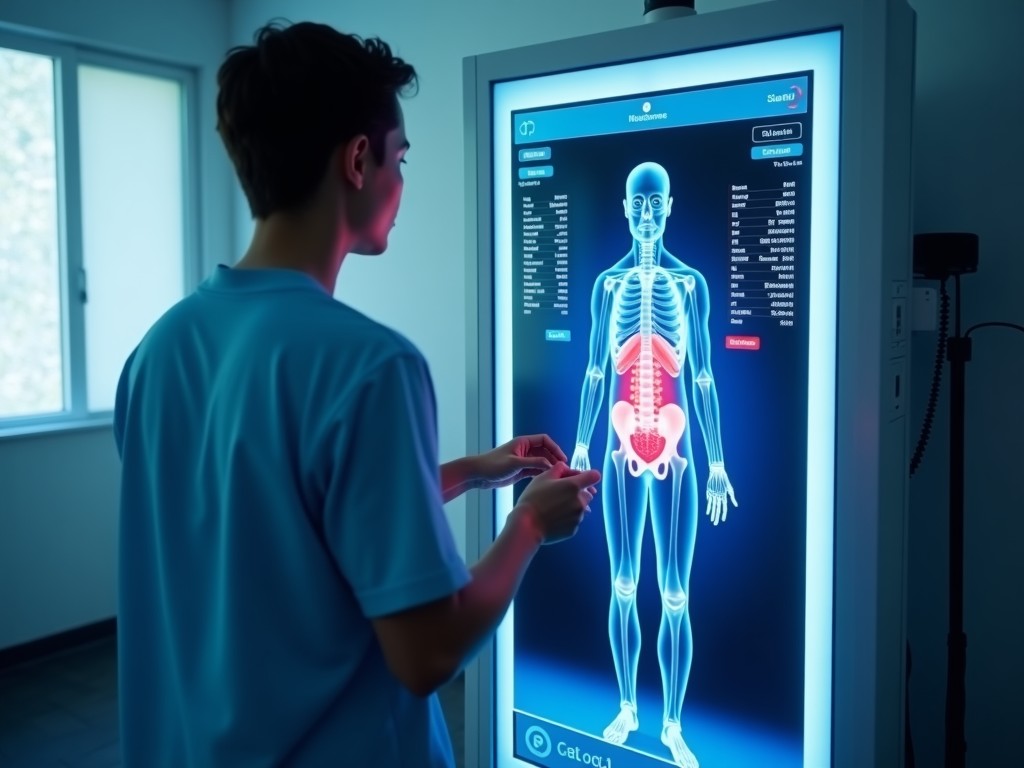
Advanced Body Fat Analyzer With Printer
This device combines multi‑frequency bioelectrical impedance analysis (BIA) with a built‑in thermal printer to provide on‑site body composition results and a hard‑copy report. The analyzer measures
Inquire NowAdvanced Body Fat Analyzer with Integrated Printer
Overview
This device combines multi‑frequency bioelectrical impedance analysis (BIA) with a built‑in thermal printer to provide on‑site body composition results and a hard‑copy report. The analyzer measures impedance at frequencies ranging from 5 kHz to 500 kHz, allowing segmentation of extracellular and intracellular water compartments.
Measurement Principle
BIA passes a low‑amplitude alternating current through the torso and limbs. The device records voltage drop and calculates impedance (Z). Using empirically derived equations that incorporate height, weight, age, and sex, the analyzer estimates total body water, fat‑free mass, and fat mass.
Multi‑frequency capability improves accuracy for individuals with varying hydration states, reducing typical measurement error to ±1.5 % body fat for adults.
Key Technical Specifications
| Parameter | Typical Value / Range |
|---|---|
| Measurement Method | Multi‑frequency BIA (5 kHz – 500 kHz) |
| Body Fat Range | 3 % – 50 % |
| Repeatability (SD) | ±0.3 % body fat |
| Weight Capacity | Up to 250 kg |
| Height Input Range | 100 cm – 220 cm |
| Power Supply | 100‑240 V AC, 50/60 Hz, 30 VA |
| Operating Temperature | 10 °C – 40 °C |
Integrated Printing Capability
The built‑in thermal printer operates at 8 dots/mm resolution, producing a 58 mm wide receipt‑style printout. Print speed is approximately 20 mm/s, allowing a full report (including segmental fat, muscle mass, basal metabolic rate, and visceral fat level) to be generated in under 5 seconds.
Print content can be configured via the device menu to include or exclude specific parameters, add a patient ID, date/time stamp, or a custom header. The printer uses standard 57 mm wide thermal rolls, which are user‑replaceable without tools.
Typical Applications
- Fitness centers and sports performance labs where trainers need immediate, printable feedback for clients.
- Clinical nutrition departments that require a hard copy for patient records and insurance documentation.
- Corporate wellness programs that administer periodic health screenings and want a tangible takeaway for employees.
- Research settings studying longitudinal changes in body composition where a printed log reduces transcription errors.
Quality Assurance and Calibration
Each unit undergoes factory verification using precision resistors and phantom tissues that simulate known impedance values. The verification protocol checks linearity across the frequency sweep and ensures the printer’s thermal head maintains consistent dot density.
Field calibration is facilitated by a built‑in self‑test routine that prompts the user to attach a supplied calibration strip; the analyzer compares the measured impedance to the strip’s certified value and adjusts internal gain factors if the deviation exceeds 0.5 %.
Manufacturing follows ISO 13485 quality‑management practices, and the design complies with IEC 60601‑2‑33 for safety of medical electrical equipment.
Customization Options
- Alternative electrode layouts (hand‑to‑hand, foot‑to‑foot, or segmental configurations) to match specific assessment protocols.
- Custom firmware language packs for multilingual user interfaces.
- Logo or branding printed on the device housing and on the thermal receipt header.
- Extended paper roll capacity (up to 80 mm diameter) for high‑volume environments.
Frequently Asked Questions
- Can the measurement electrodes be replaced? Yes, the disposable electrode pads are standard 50 mm × 30 mm gel pads, available in packs of 100.
- What information is required before quotation? Please provide intended usage environment (e.g., clinic, gym), expected daily throughput, and any specific printing format requirements.
- How is the printer maintained? The thermal head should be cleaned with isopropyl alcohol swabs after every 2 km of printed length; no lubrication is needed.
- What is the typical production lead time? Standard configurations ship within 3‑4 weeks after receipt of purchase order; customized units may require an additional 1‑2 weeks.