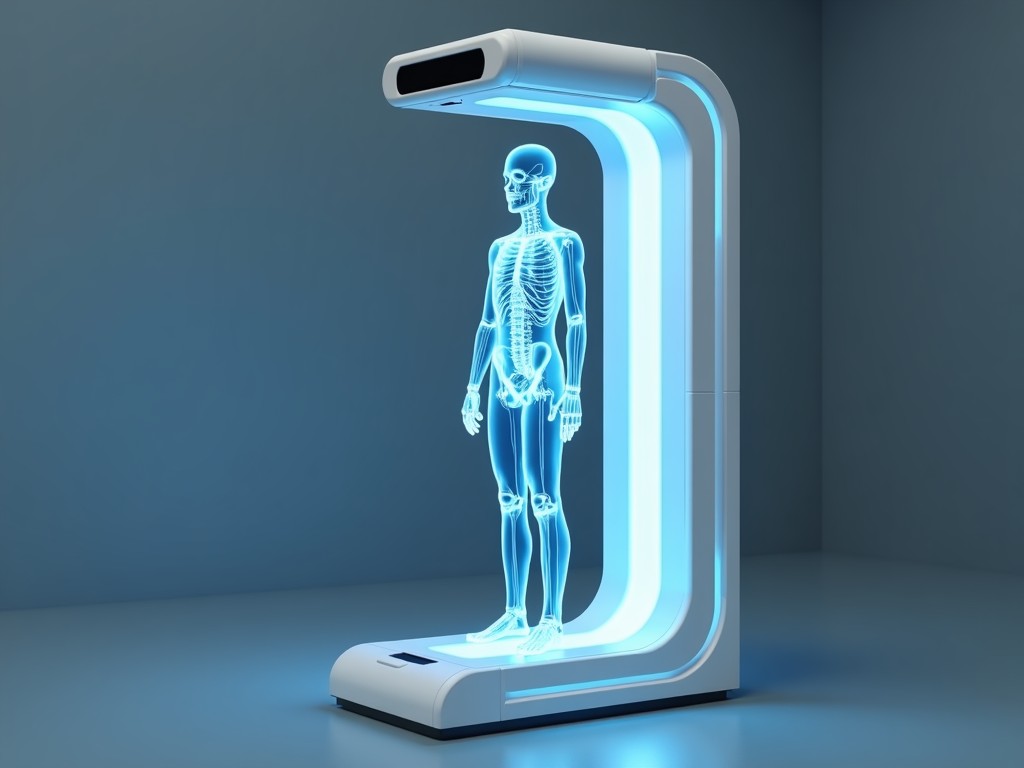
Cost Effective 3D Body Scanner Mirror
A 3D body scanner mirror captures body geometry by projecting a known light pattern onto the subject and recording the pattern's deformation via a single reflective surface. The mirror redirects the
Inquire NowCost-Effective 3D Body Scanner Mirror
A 3D body scanner mirror captures body geometry by projecting a known light pattern onto the subject and recording the pattern's deformation via a single reflective surface. The mirror redirects the distorted pattern to a camera sensor, where software calculates depth information through triangulation.
Technical Specifications
| Parameter | Typical Value |
|---|---|
| Scan Area (W x H x D) | Up to 2000 mm × 1500 mm × 500 mm |
| Resolution | 0.5 mm point spacing |
| Accuracy (volumetric) | ±2 mm over full scan area after correction |
| Frame Rate | 30 fps (global shutter) |
| Illumination | LED strobe, 635 nm ±10 nm |
| Power Supply | 24 VDC, 2 A max |
| Operating Temperature | 10 °C – 40 °C |
| Weight | < 2 kg (mirror + frame) |
Design and Construction
The mirror substrate is typically made of float glass or acrylic with a thickness of 3–5 mm to provide sufficient rigidity while keeping weight low. A first‑surface aluminum coating is applied to minimize ghosting and ensure that the reflected pattern retains high contrast. The mirror is mounted in a lightweight aluminum frame that includes adjustable tilt brackets for alignment with the projector and camera axes.
Mounting interfaces consist of M6 threaded holes on the frame sides, allowing the scanner to be attached to existing studio rigs, conveyor side‑guards, or portable tripod adapters. The frame design avoids internal moving parts, which reduces wear and eliminates the need for periodic lubrication.
Performance Characteristics
Measurement accuracy depends on baseline distance between projector and camera, pattern frequency, and calibration quality. In typical configurations with a 500 mm baseline, the system achieves a volumetric error of less than ±2 mm over the full scan area after polynomial distortion correction.
Frame capture rates of 30 fps are achievable with a global‑shutter camera and LED strobe illumination synchronized to the projector. A full‑body scan can be completed in under 2 seconds, including data transfer and mesh generation.
Key Advantages
- Reduced component count eliminates lenses and moving mirrors, lowering bill‑of‑materials cost.
- Passive optics simplify alignment; factory calibration remains stable over temperature variations typical of indoor environments.
- Lightweight construction (< 2 kg) enables handheld or robot‑mounted configurations without additional support structures.
- First‑surface coating minimizes internal reflections, improving signal‑to‑noise ratio in high‑ambient‑light settings.
Typical Applications
In apparel manufacturing, the scanner provides rapid capture of body measurements for pattern grading, reducing reliance on manual tape measures and improving size‑chart consistency.
Ergonomics laboratories use the device to assess posture and workspace fit, where the non‑contact nature prevents interference with clothing or equipment.
Virtual fitting rooms integrate the scan data into avatar creation pipelines, enabling real‑time clothing simulation with sub‑centimeter fidelity.
Customization Options
Scan volume can be adjusted by changing the baseline distance between projector and camera or by selecting mirrors with different effective apertures.
Coating alternatives include protected silver for higher reflectivity in the visible spectrum or dielectric stacks for specific wavelength bands (e.g., near‑infrared).
Output interfaces support USB 3.0, GigE, or Camera Link, and the accompanying software provides SDKs for C++, Python, and LabVIEW.
Quality Assurance
Each unit undergoes a two‑step verification: first, an interferometric test confirms surface flatness within λ/10 across the clear aperture; second, a traceable artifact scan validates measurement repeatability against a calibrated gauge block set.
Environmental testing includes temperature cycling from 10 °C to 40 °C and humidity exposure up to 80 % RH to ensure coating adhesion and mechanical stability.
Frequently Asked Questions
Can the scan area be customized?
Yes. The effective field of view is determined by the mirror size and the projector‑camera baseline; both parameters can be adjusted to meet specific part dimensions.
What information is required for a quotation?
Required details include desired scan volume, resolution target, illumination wavelength, preferred output interface, and any environmental constraints such as temperature or vibration limits.
How is the mirror coating protected against wear?
A protective overcoat of silicon dioxide is applied over the reflective layer, providing resistance to abrasion and chemical exposure while maintaining optical performance.
Contact for Inquiry
To request a quotation, discuss customization options, or obtain technical documentation, please reach out to our technical sales team.
Contact Sales