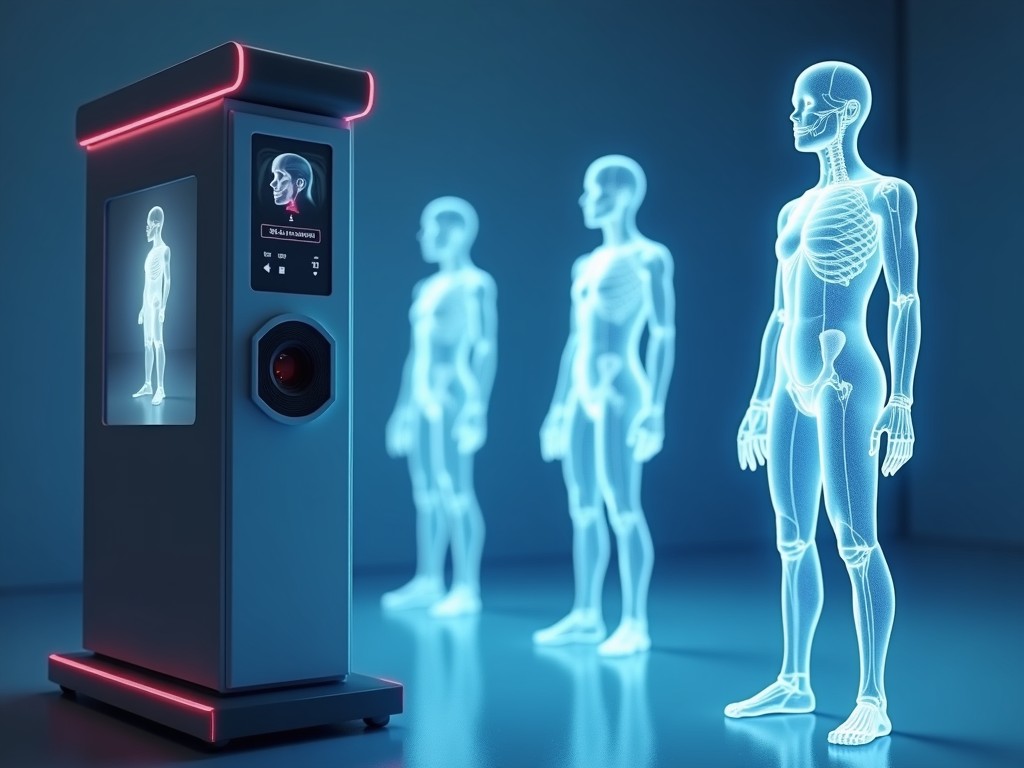
Wholesale Fitness 3D Body Scanner Factory
A fitness 3D body scanner captures the three‑dimensional shape of a human body in seconds, producing a dense point cloud that can be processed into circumferential measurements, volume estimates, and
Inquire NowWholesale Fitness 3D Body Scanner Factory
A fitness 3D body scanner captures the three‑dimensional shape of a human body in seconds, producing a dense point cloud that can be processed into circumferential measurements, volume estimates, and posture analysis. The technology relies on structured light or multi‑camera photogrammetry to achieve sub‑millimeter resolution without physical contact.
Operating Principle
The scanner projects a known pattern of infrared stripes onto the subject. Deformation of the pattern caused by body contours is recorded by high‑speed sensors. Triangulation algorithms convert the displacement into XYZ coordinates, generating a mesh with typical point spacing of 0.5 mm. The process completes in under 8 seconds, allowing high‑throughput scanning in gym or clinic settings.
Key Technical Specifications
| Parameter | Typical Value |
|---|---|
| Scanning Volume | 2000 mm × 1000 mm × 600 mm (W × D × H) |
| Point Spacing | 0.5 mm |
| Measurement Accuracy | ±2 mm (circumference) |
| Scan Speed | ≤8 seconds per full body |
| Power Consumption | 120 W (average) |
| Overall Dimensions | 2100 mm × 1100 mm × 2100 mm (W × D × H) |
| Weight | 180 kg |
Industrial Applications
Fitness facilities require rapid, repeatable body composition tracking to personalize training programs and demonstrate progress to clients. A 3D scanner provides objective data that calipers or bio‑impedance cannot match, especially for asymmetrical morphologies or clients with limb prostheses.
- Member onboarding and baseline assessment
- Progress monitoring for weight‑loss or muscle‑gain programs
- Custom apparel fitting for sports gear manufacturers
- Ergonomic analysis in corporate wellness centers
Customization Options
Factory production allows adjustments to scanning envelope, lighting wavelength, and software interfaces to match specific facility workflows. Optional modules include integrated heart‑rate sensors, Wi‑Fi data upload, and multilingual user guides.
- Extended height range up to 2200 mm for basketball teams
- Enclosure with antimicrobial coating for high‑traffic gyms
- API package for synchronization with existing membership platforms
- Ruggedized version with IP54 rating for outdoor boot‑camp sites
Quality Assurance & Testing
Each unit undergoes a three‑stage verification: optical alignment check using a calibrated gauge block, repeatability test with a static mannequin (±0.3 mm variance over 30 scans), and software validation against a NIST‑traceable surface profile. Documentation includes a test report and calibration certificate.
Packaging and Logistics
Scanners are shipped in double‑wall corrugated crates with internal foam cushions that limit vibration to <2 g. Corner protectors and humidity‑absorbing packets are included. Standard export packaging meets ISPM‑15 wood‑treatment requirements.
Ordering Information
To receive a formal quotation, provide the required scanning volume, any desired accessories, and the destination port. Lead time typically ranges from 6 to 8 weeks after deposit, depending on customization complexity.
For further details or to request a sample unit, contact our sales team.
Investing in a factory‑sourced 3D body scanner ensures consistent performance, traceable calibration, and long‑term support for fitness‑center operators seeking data‑driven member engagement.