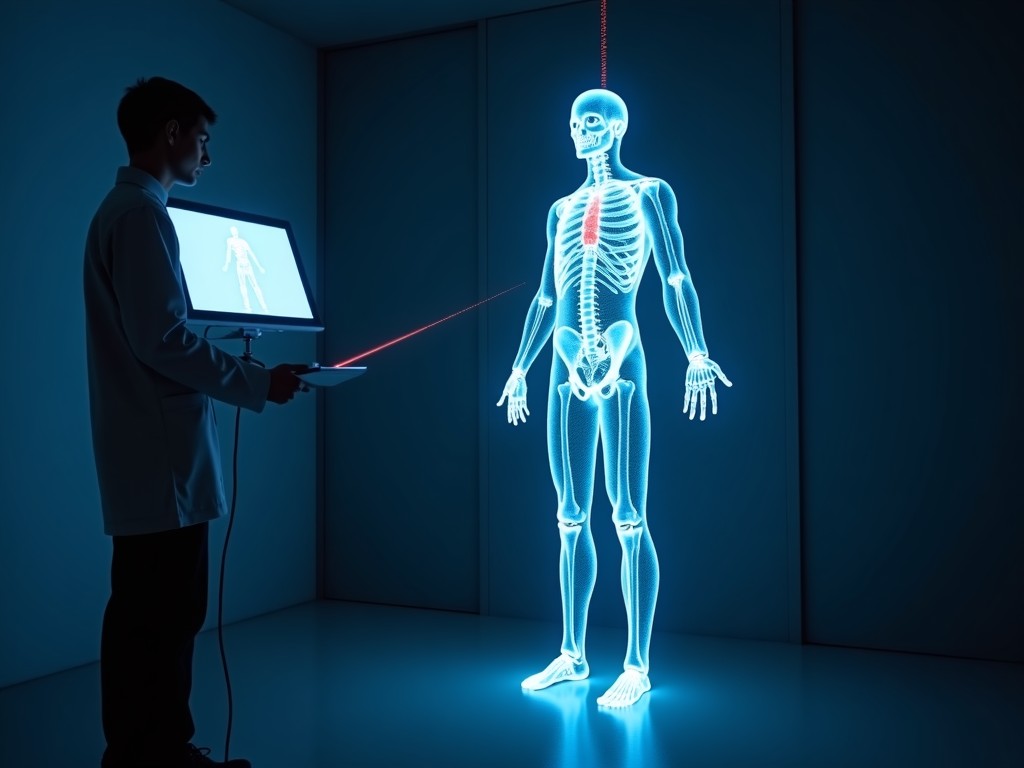
Odm 3D Laser Body Scanner
An ODM 3D laser body scanner captures the full‑surface geometry of a human or object using laser triangulation. The system projects a structured laser line onto the target and records the deformation
Inquire NowODM 3D Laser Body Scanner
Overview
An ODM 3D laser body scanner captures the full‑surface geometry of a human or object using laser triangulation. The system projects a structured laser line onto the target and records the deformation with high‑resolution sensors to generate a point cloud. This non‑contact method provides repeatable measurements without physical markers or dyes.
Core Technology
The scanner employs a pair of calibrated CMOS cameras operating at 120 fps synchronized with a 650 nm laser diode. Triangulation accuracy is derived from the baseline distance between the lenses and the known laser angle, yielding sub‑millimeter depth resolution. Real‑time processing filters ambient light and motion blur to maintain data integrity on moving subjects.
Key Technical Parameters
| Parameter | Typical Value | Notes |
|---|---|---|
| Scanning Volume | 500 mm × 500 mm × 500 mm | Customizable up to 2 m on request |
| Point Spacing | 0.2 mm | Adjustable via lens selection |
| Frame Rate | 30 frames / second | Full‑resolution capture |
| Laser Safety Class | Class 2 (MPE < 1 mW) | Eye‑safe for indirect viewing |
| Output Formats | PLY, OBJ, STL, ASCII XYZ | Selectable in software |
Applications
In automotive ergonomics, the scanner provides rapid capture of driver posture for seat‑belt anchorage validation, reducing reliance on physical mock‑ups. Apparel manufacturers use the point cloud to generate custom‑fit patterns, minimizing material waste during prototyping. Healthcare providers employ the data for prosthetic socket design, ensuring load‑distribution analysis based on actual anatomy.
- Vehicle interior ergonomics studies
- Custom sports equipment fitting
- Animation and virtual‑reality avatar creation
- Anthropometric research surveys
Customization Options
The scanner’s optical head can be swapped to alter the field‑of‑view, enabling either high‑detail facial scans or full‑body captures. Software modules allow users to define custom mesh‑decimation thresholds, color‑mapping from integrated RGB cameras, or export directly to CAD environments. Communication interfaces include USB 3.0, GigE, and optional wireless modules for portable deployments.
- Laser wavelength (635 nm, 650 nm, 780 nm)
- Baseline distance adjustment (50 mm–200 mm)
- External trigger synchronization
- Protective enclosure for harsh environments
Quality Control & Calibration
Each unit undergoes a two‑point calibration using a traceable reference plate with certified step heights. The verification process checks laser line uniformity, camera pixel scaling, and temperature drift compensation. A calibration certificate is provided, and the system supports user‑initiated verification via a supplied calibration kit to maintain long‑term measurement confidence.
Frequently Asked Questions
Can the scanning volume be adjusted after purchase?
Yes, the optical head and baseline are modular; alternative lenses and mounting brackets enable volume changes without replacing the entire scanner.
What file formats are available for downstream processing?
The software exports PLY, OBJ, STL, and ASCII XYZ; additional formats can be added via SDK upon request.
Is on‑site installation and training provided?
Standard offering includes one‑day installation, alignment verification, and operator training; extended support contracts are available.
Next Steps
To discuss how the ODM 3D laser body scanner can be integrated into your specific workflow, provide your application details, required scanning volume, and any interface constraints. Our engineering team will evaluate the configuration and return a detailed quotation with lead‑time information.
Request a Quotation