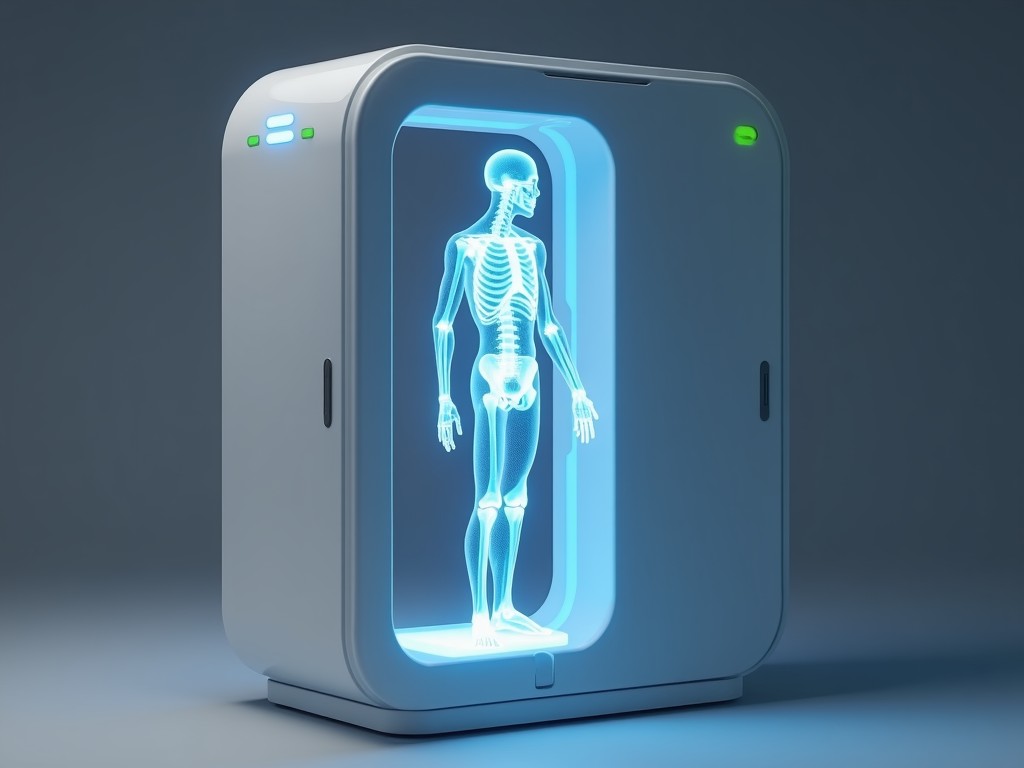
Buy 3D Full Body Scanner Manufacturer
A 3D full body scanner projects structured light or laser stripes onto a subject and captures the deformation with multiple sensors to reconstruct a dense point cloud. The resulting dataset provides
Inquire NowBuy 3D Full Body Scanner – Manufacturer Overview
A 3D full body scanner projects structured light or laser stripes onto a subject and captures the deformation with multiple sensors to reconstruct a dense point cloud. The resulting dataset provides millimeter‑level surface detail for ergonomic, medical, or apparel applications.
Technical Specifications
| Parameter | Typical Value |
|---|---|
| Scanning Volume (W×H×D) | 2000 mm × 2000 mm × 1000 mm |
| Point Spacing | 0.2 mm |
| Volumetric Accuracy | ±0.5 mm |
| Scan Speed (full body) | 12 s | Light Source | Blue LED structured light, 405 nm |
| Power Consumption | 150 W (max) |
| Output Formats | PLY, OBJ, STL, XYZ |
| Operating Temperature | 10 °C – 35 °C |
Applications
The scanner’s measurement volume and accuracy make it suitable for sectors where precise human shape data drives design or analysis.
- Apparel and footwear companies use the mesh to create parametric avatars for virtual fitting, reducing physical sample cycles.
- Ergonomics consultants capture posture data to evaluate workstation reach and clearance, improving injury prevention programs.
- Medical facilities obtain baseline body scans for prosthetic fitting, orthotic design, and longitudinal morphology studies.
- Entertainment studios generate high‑resolution meshes for character modeling, decreasing manual sculpting time.
- Fitness centers provide clients with precise body‑composition visuals linked to circumferential measurements.
Customization Options
Manufacturers adapt the scanner to site‑specific constraints such as ceiling height, lighting conditions, or integration with existing software pipelines.
- Adjustable frame height (1500 mm–2500 mm) to accommodate low‑clearance rooms.
- Optional external lighting kits for bright ambient environments.
- Choice of scan modes: high‑density (0.15 mm spacing) for detailed surface texture or rapid (0.3 mm spacing) for throughput.
- Software SDKs available for C#, Python, and Unity to embed scanning functions into proprietary applications.
- Enclosure materials: powder‑coated steel or aluminum with optional antimicrobial coating.
Quality Control Philosophy
Each unit undergoes a three‑stage verification process before shipment to ensure measurement traceability.
- Optical alignment checked using a calibrated reference artifact; deviation must be under 0.05 mm.
- Repeatability test performed on a standardized mannequin; ten consecutive scans must show variance below 0.2 mm RMS.
- Software validation confirms output file integrity and correct coordinate system orientation.
Frequently Asked Questions
Can the scanning volume be changed?
Yes, the frame is modular; alternative width and depth extensions are available upon request, subject to structural stability analysis.
What file formats does the scanner output?
Raw point clouds are exported as PLY or XYZ; meshed surfaces are provided as OBJ or STL. Custom formats can be arranged via the SDK.
Is on‑site installation and training provided?
Installation includes mechanical alignment, software configuration, and two days of operator training. Additional days can be quoted.
Next Steps
To discuss how a 3D full body scanner can meet your specific measurement requirements, provide your project details and we will respond with a technical quotation and lead‑time estimate.