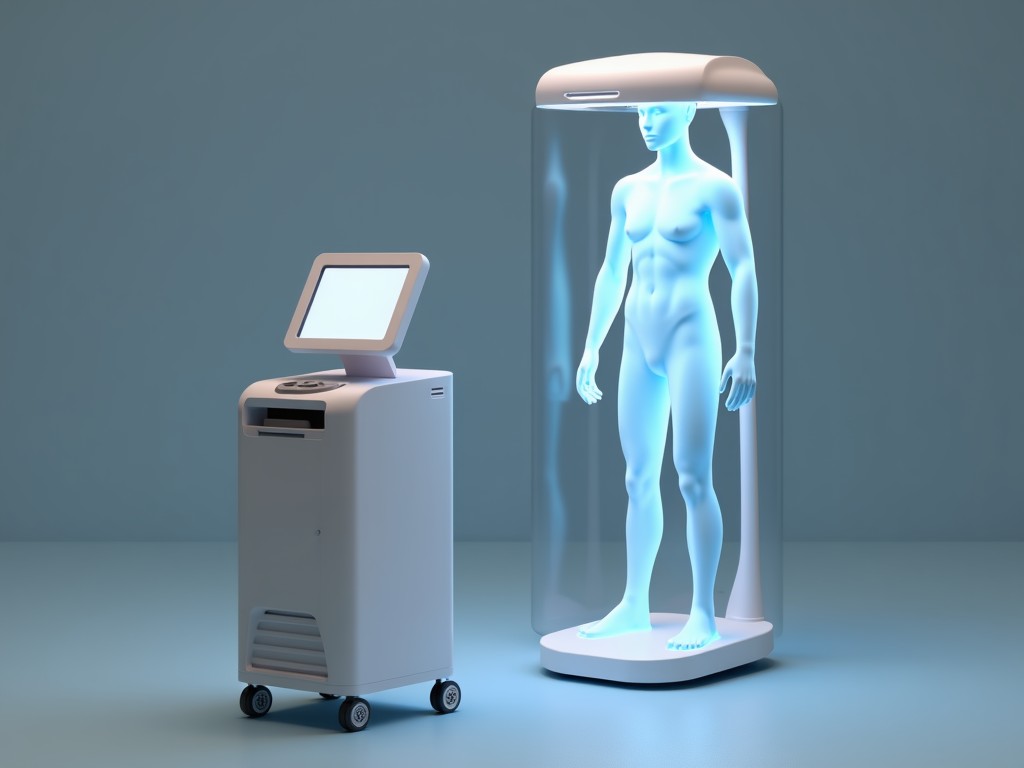
Budget Friendly Fitness 3D Body Scanner Machine
A 3D body scanner captures the external shape of a person in milliseconds, producing a point cloud or mesh that can be analyzed for circumference, volume, and posture metrics. In fitness settings,
Inquire NowBudget Friendly Fitness 3D Body Scanner Machine
A 3D body scanner captures the external shape of a person in milliseconds, producing a point cloud or mesh that can be analyzed for circumference, volume, and posture metrics. In fitness settings, this data supports objective tracking of body composition changes without the need for calipers or invasive measurements.
Key Technical Specifications
| Parameter | Typical Value |
|---|---|
| Scanning Volume (W×H×D) | 800 mm × 2000 mm × 600 mm |
| Point Spacing (Resolution) | ≤2 mm |
| Scan Time | < 12 s per full body |
| Light Source | Eye‑safe structured LED (Class 1) |
| Power Consumption | 45 W (average) |
| Dimensions (Footprint) | 900 mm × 700 mm × 150 mm |
| Weight | 22 kg |
| Data Output | OBJ, PLY, CSV via USB 3.0 or Ethernet |
| Operating Temperature | 10 °C – 35 °C |
Operating Principles
The scanner projects a series of known patterns onto the subject using infrared‑transparent LEDs. Two synchronized cameras capture the deformation of these patterns from different angles, enabling triangulation of surface points. Because the light intensity is well below IEC 62471 Class 1 limits, the procedure poses no thermal or photobiological risk and can be repeated daily.
Typical Applications in the Fitness Industry
Fitness centers use repeatable scans to monitor muscle hypertrophy, fat loss, and postural shifts over weeks or months. By exporting circumferential data (waist, hip, thigh, arm) trainers can correlate measurements with performance metrics, adjusting programs based on concrete evidence rather than subjective feel.
- Baseline assessment for new members
- Progress tracking for personal‑training clients
- Group‑challenge analytics (e.g., corporate wellness)
- Ergonomic fitting for equipment sizing
Customization and Integration Options
The core scanning head is offered as a modular unit, allowing OEMs to embed it into custom enclosures or integrate with existing member‑management software. Optional accessories are selected according to facility layout and data‑security requirements.
- Wall‑mount or floor‑stand brackets (adjustable height)
- Wireless LAN module (802.11ac) for cable‑free installations
- SDK (C#, Python) for real‑time data streaming
- Optional privacy curtain with antimicrobial fabric
- Enclosure finishes: powder‑coated steel, ABS plastic, or brushed aluminum
Quality Control and Manufacturing Considerations
Each unit undergoes a two‑stage calibration: first, a reference gauge verifies point‑spacing accuracy across the full volume; second, a repeatability test scans a static mannequin ten times, confirming variance under 0.5 mm RMS. Housing components are selected for low thermal expansion (≤12 ppm/°C) to maintain optical alignment during extended operation.
Frequently Asked Questions
Can the scanning volume be increased for taller athletes?
The standard head covers up to 2 m height; extensions are available upon request, involving additional LED bars and camera lenses, which increase footprint and power draw proportionally.
What file formats are compatible with common fitness‑tracking platforms?
The scanner exports OBJ and PLY for mesh processing, while CSV provides segment circumferences that can be imported directly into most CRM or athlete‑monitoring software via simple mapping.
Is on‑site training required for staff operation?
A one‑hour hands‑on session covers positioning, initiation of a scan, and basic data retrieval; detailed manuals and video guides are provided for reference.
Ready to Evaluate?
Contact our engineering team to discuss site‑specific requirements, receive a detailed quotation, or arrange a virtual demonstration.
Request a Quote