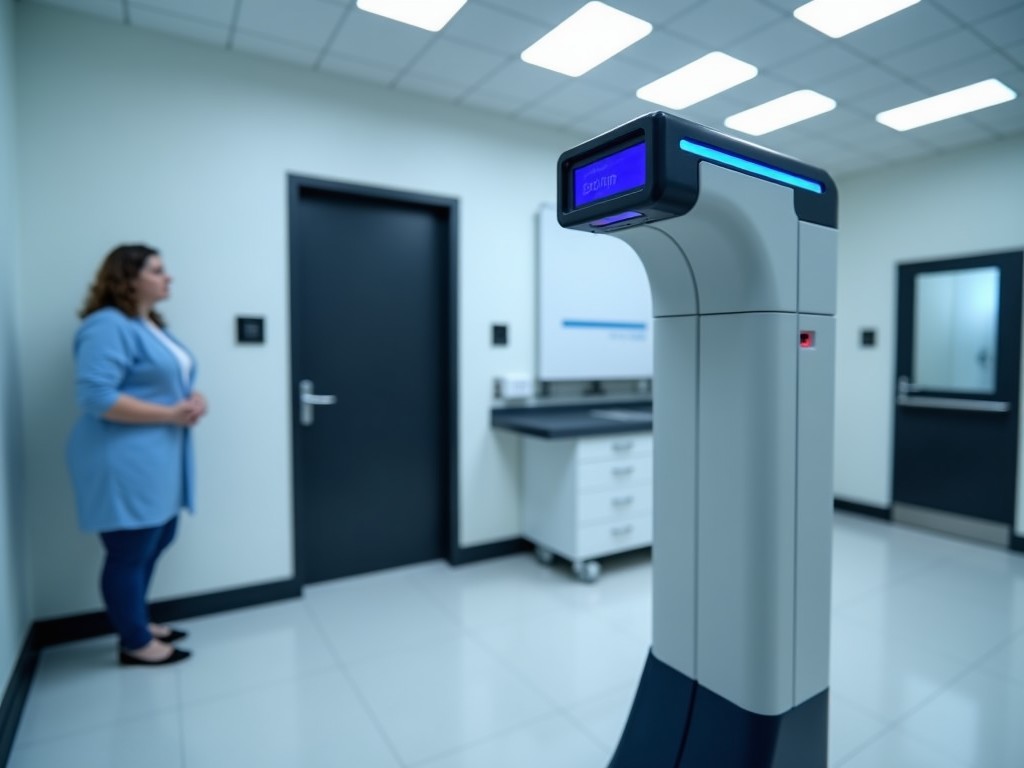
Budget Friendly All Body Scanner Product Exporter
The system is a walk‑through full‑body inspection unit that uses a low‑dose fan‑beam X‑ray source coupled to a linear detector array. It produces a transmissiographic image of the entire body in a
Inquire NowBudget Friendly All Body Scanner – Product Overview
The system is a walk‑through full‑body inspection unit that uses a low‑dose fan‑beam X‑ray source coupled to a linear detector array. It produces a transmissiographic image of the entire body in a single pass, allowing operators to detect concealed metallic and non‑metallic threats without physical contact.
Because the hardware relies on solid‑state detectors and a simplified mechanical drive, the capital expense is typically 30‑40 % lower than comparable multi‑view systems while maintaining throughput suitable for high‑traffic checkpoints.
Key Technical Features
The scanner operates at a tube voltage of 80 kVp with a filament current adjusted to keep the effective dose per scan below 0.1 µSv, a level comparable to natural background radiation received in a few minutes.
Detector pixel pitch is 0.4 mm, yielding a typical spatial resolution of 0.8 mm at a source‑to‑detector distance of 1 m. Scan speed is adjustable up to 0.5 m/s, which translates to a nominal throughput of 250 persons per hour when a 2‑second interval is used for image assessment.
Power consumption averages 1.2 kW during active scanning and drops to <0.2 kW in idle mode. Overall dimensions are 2.4 m (L) × 0.9 m (W) × 2.2 m (H) with a net weight of approximately 350 kg, allowing installation through standard doorways.
| Parameter | Typical Value | Unit | Notes |
|---|---|---|---|
| Scan Technology | Fan‑beam X‑ray | – | Single‑sided acquisition |
| Spatial Resolution | 0.8 | mm | At 1 m SID |
| Scan Speed | 0.5 | m/s | Adjustable |
| Effective Dose | <0.1 | µSv per scan | Comparable to background |
| Power Consumption | 1.2 | kW (active) | <0.2 kW idle |
| Overall Dimensions | 2.4 × 0.9 × 2.2 | m (L×W×H) | Through standard doorway |
| Weight | 350 | kg | Net |
| Throughput | 250 | persons/hour | 2 s assessment interval |
Typical Applications
Facilities that require rapid screening of individuals while maintaining a welcoming environment benefit from this technology. The low radiation dose permits repeated use in settings where personnel undergo daily checks.
- Airport and railway terminals – detection of concealed weapons or contraband without slowing passenger flow.
- Correctional facilities – routine visitor screening to prevent introduction of prohibited items.
- Large‑scale event venues – rapid entry screening for concerts, sports matches, and conventions.
- Manufacturing plants with high‑value inventory – staff exit checks to deter theft of small components.
Customization Options
The base configuration can be adapted to site‑specific constraints through a set of modular choices that do not alter the core imaging physics.
- Adjustable scan height (range 1.4 m to 2.0 m) to accommodate diverse user populations.
- Configurable alarm thresholds for material‑specific attenuation values, enabling focus on metals, plastics, or liquids.
- Optional integration with access‑control systems (turnstiles, badge readers) via Ethernet or discrete I/O.
- Choice of detector scintillator material (e.g., CsI:Ti or Gd₂O₂S:Tb) to optimize image contrast for specific threat signatures.
Quality Assurance & Testing
Each unit undergoes a factory acceptance test that includes dose uniformity mapping across the scan volume, spatial resolution verification using a wire grid phantom, and functional validation of the alarm logic under varied background conditions.
Environmental stress testing covers temperature cycling from ‑10 °C to +50 °C and relative humidity up to 95 % non‑condensing, ensuring reliable operation in indoor semi‑controlled environments. A statistical process control chart tracks key parameters such as tube current stability and detector gain drift over a 500‑hour burn‑in period.
Packaging & Export Logistics
The scanner is packed in a double‑wall corrugated crate equipped with custom‑cut polyethylene foam inserts that immobilize the detector array and X‑ray tube assembly. Shock‑watch indicators and humidity cards are affixed to the exterior to provide handlers with transit condition feedback.
Export documentation includes a commercial invoice, packing list, material safety data sheet for the X‑ray tube, and a certificate of conformity to the relevant IEC radiation safety standards. All pallets are ISPM‑15 treated for international shipment.
Frequently Asked Questions
Can the scan height be adjusted after installation?
Yes, the vertical positioning mechanism uses a motorized lift with limit switches, allowing re‑configuration within the specified range without tools.
What information is required before quotation?
Needed details include expected daily throughput, facility ceiling height, power availability (voltage/frequency), and any desired integration points with existing security systems.
Which materials are available for the detector?
Standard offerings are cesium iodide doped with thallium (CsI:Ti) and gadolinium oxysulfide doped with terbium (Gd₂O₂S:Tb); alternative scintillators can be quoted upon request.
How is quality inspected before shipping?
Every system passes a 2‑hour stability test, dose map verification (<5 % variance across the field of view), and functional alarm test using industry‑standard threat simulators.
Request a Quote
To discuss how this budget‑friendly full‑body scanner can be tailored to your site’s security workflow, please provide your project specifics via the contact form. Our engineering team will return a detailed technical proposal including lead time, pricing, and optional accessory list within two business days.