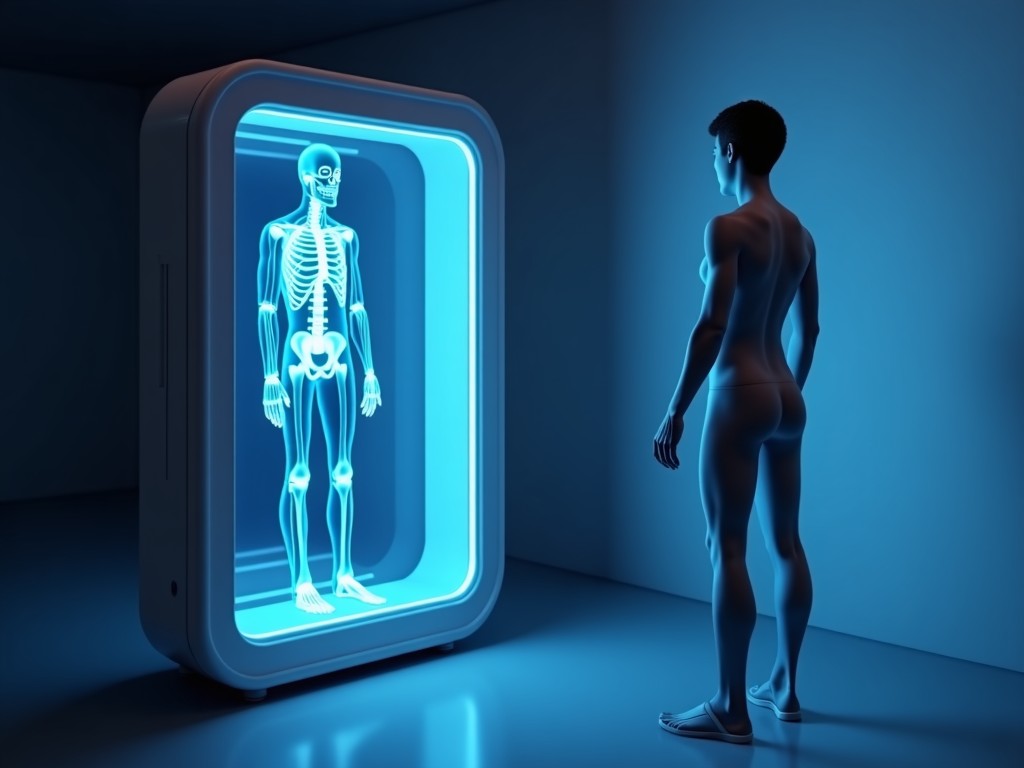
3D Body Scanner For Fitness
A 3D body scanner captures the external shape of a person in seconds by projecting a known pattern and measuring its deformation. The resulting point cloud is converted into a watertight mesh that
Inquire Now3D Body Scanner for Fitness Applications
Overview
A 3D body scanner captures the external shape of a person in seconds by projecting a known pattern and measuring its deformation.
The resulting point cloud is converted into a watertight mesh that represents the body's surface with sub‑millimeter detail.
This data enables fitness professionals to track morphological changes over time without relying on circumferences or weight alone.
Technology
The system uses an array of infrared depth sensors combined with structured light projection.
Each sensor operates at a Class 1 eye‑safe laser wavelength, allowing safe use in clothing‑optional environments.
Frame rates of 30 frames per second enable capture of natural posture and subtle movement.
Key Specifications
Typical performance values are listed below; actual numbers can be adjusted to match project requirements.
| Parameter | Typical Value | Notes |
|---|---|---|
| Scanning Volume | 2.0 m × 2.0 m × 2.5 m (W × D × H) | Can be extended with optional lenses |
| Measurement Accuracy | ±2 mm (overall) | Dependent on calibration and pose |
| Repeatability | <0.5 mm RMS | After warm‑up, stable environment |
| Frame Rate | 30 fps | Sufficient for dynamic capture |
| Output Formats | OBJ, STL, PLY, JSON | Custom schemas available on request |
| Power Consumption | 120 W | Typical operating load |
| Operating Temperature | 10 °C – 40 °C | Non‑condensing humidity |
Typical Applications in Fitness
Fitness centers use the scanner to obtain baseline body shape for personalized training programs.
Apparel manufacturers leverage the mesh to create custom‑fit garments, reducing return rates.
Rehabilitation clinics compare pre‑ and post‑intervention scans to quantify muscle hypertrophy or atrophy with objective metrics.
Factors Influencing Measurement Accuracy
Ambient infrared interference can degrade depth quality; the scanner includes optical filters to mitigate this effect.
Wearing loose clothing adds a layer that the algorithm treats as part of the surface; minimal‑form attire is recommended for highest precision.
Regular calibration using a reference artifact traceable to ISO 17025 ensures the ±2 mm specification is maintained over time.
Data Integration and Output Options
The scanner streams raw depth frames via Gigabit Ethernet, allowing real‑time feedback to connected devices.
Post‑processing software converts the frames to a mesh and exports standard formats compatible with CAD, animation, and fitness analytics platforms.
A RESTful API provides access to extraction of circumferential measurements, volume, and segmental masses without requiring intermediate file handling.
Manufacturing and Quality Assurance
Each unit undergoes a two‑step verification: first, a geometric check using a calibrated gauge block array; second, a functional test with a moving mannequin to validate frame‑rate and data integrity.
Software firmware is version‑controlled and released only after passing regression tests that compare scan outputs against a master dataset.
Documentation includes a calibration certificate and a traceability matrix linking critical components to their source inspection records.
Frequently Asked Questions
- Can the scanning volume be enlarged for taller individuals? Yes, the optics can be re‑configured; maximum height is limited by sensor focal length and safety constraints.
- What file formats are available for direct import into fitness tracking software? The system outputs OBJ, STL, PLY, and a custom JSON schema that includes segmental volumes and surface area.
- How is the scanner powered and what are the installation requirements? It runs on a standard 110‑220 V AC supply, draws approximately 120 W, and requires a dedicated Gigabit Ethernet port for data transfer.
- Is special training required to operate the scanner? Operators complete a brief certification covering safety, pose instruction, and software workflow; typical training lasts under two hours.
- What is the recommended maintenance interval for calibration? A full calibration is advised every six months or after any relocation, with interim verification using a supplied reference plate each month.
Technical Consultation
To discuss how a 3D body scanner can be integrated into your fitness facility or product development process, contact our engineering team.
Request a Technical Consultation